


Fifth-generation mobile communication is one of the fastest-growing wireless communication technologies. Get to Know about Top 12+ 5G simulation tools. Let’s start with a question, i.e., what are the expected demands out of 5G?
- Enhancement of reliability
- Increased throughput
- Efficiently working in the mix of high traffic
For these purposes, proper hardware and software have to be deployed, and at the same time, some parameters have to be optimally managed inevitably. The following are the important parameters in 5G simulation that have to be considered by researchers
- Positioning of the network (based on the density of deployment – dense, ultra-dense, and very dense)
- Requirements of software and hardware capacity along with the coverage
- Bandwidth
- The increased power of transmission
- Categorizing and dimensioning of parameters to be based on the optimum level
- Reduce the cost of acquisition
- Higher throughput
- A minimal amount of energy radiation
- Handover zone optimization
There is still a lot to know about the optimum dimensioning about which our experts have gained great knowledge. It is important to be noted that the condition for optimum functioning of the communication network depends primarily on the environment and situation in which it is being implemented. Now let us see in detail.
- The very first conditions for optimum dimensioning are the following two criteria
- Minimal cost for acquisition of the site
- The maximum value of throughput
- The constraint of the system are also two in number
- Deployment density at transmission and reception
- The bandwidth of the system
- There are also four network options to be determined for positioning, which include the following
- Deployment density
- Very dense
- Dense
- Ultra-dense
- Deployment density
- The two requirements for the distribution of control nodes in network distribution are as follows
- Requirements of coverage
- Capacities both hardware and software that are required
Thus, we can choose the best 5G Network revolutionary option that can be implemented in real-time. Our developers gained big experience in working with different 5G simulation tools. You can readily approach us without any hesitation to get your doubts about simulation software solved. This article will give you a complete idea of different simulation tools for 5G networks. Let us first start by understanding it’s working.
5G network project has to be simulated to test its performance under various real-time situations. So it can be used to test the network and its requirements even before implementation. The following are the steps based on which a 5G simulation tool works.
HOW DOES THE 5G SIMULATION WORK?
We have listed below important points regarding simulation working model, based on this we can select best 5g simulation tools for your research work.
- 5G network simulation for various base stations and nodes have to be determined
- The 5G network architecture is to be defined for cross layers
- 6 GHz is the minimum range of frequency of the spectrum
- Transmission has to happen securely
- Security in multiple layer connection should be ensured
- LTE device performance should be achieved at a high degree
- Cellular networks for multiple sectors supported
- Modeling and management of network carrier
- Managing the frequency of the spectrum
- LTE connectivity at multiple levels

Our experts are here to support you in all aspects regarding the working of any 5G simulator. You can interact with us and have an idea of choosing the best 5G simulation tools for your project. The following are the major steps involved in 5G simulation using any standard simulator.
- The proper scenarios are to be selected
- Assignment of MS location and path loss determination is the next step
- Coefficients of the channel are generated
- Service for each MS is requested
- Allocation of the channel and modulation are performed
- Assignment of precoding matrix is the next step
- Signal to noise ratio is effectively calculated
The deployment of 5G towers, virtual nodes, servers, base stations, and controllers requires different libraries and several tools and predicting network behavior. Our technical team is well known for its experience in advanced 5G simulation architecture. From our technical knowledge, we will guide you through the process of making the best 5G simulation software. Now let us understand the different simulators that are present today.
5G NETWORK SIMULATORS
Before getting into the different simulators available for simulation of 5G network projects, we should have a quick look at its broad classification.
- System-level simulations– these are affected by the exchanged messages and packet flows (examples include extend sim and SIM grid)
- Full-stack simulations(packet-level simulations) – these kinds of simulators include ns2, ns3, OPNET, OMNET ++, and QUALNET
You should be very cautious while using these simulators because the simulation you choose should align with your project objective. Such circumstances where the simulators are to be deployed can use more than one simulation tool to complement each other.
Now let us see in detail different packet-level simulation tools.
- NS2 simulator
- The ns2 simulator is an open-source platform that is also user friendly to be a part of 5G network simulation
- OPNET Network simulator
- LTE – A model (IEEE 802.15c standard) is used for simulation
- It supports OPNET 18.0 standard
- It can be better used for analyzing the performance of many different network types
- MATLAB and Matlab Simulink
- Generally, MATLAB is used for the simulation of many projects, including 5G networks
- The 5G toolboxpresent in Matlab are specifically attributed to doing the following
- Generating signals
- Modeling of channels
- Simulations at the link level
- Toolbox for antenna, LTE system, a system of communication, SimRF, a system of the phased array is present in MATLAB Simulink
- Novel algorithms and infrastructure of 5G network are deployed using this simulator
- FPGA hardware prototyping using the platform of SDR is supported in the unified environment (dynamic)
- OMNET ++
- MIXIM framework – IEEE 802.11.3ad + SimuLTE and INET framework – IEEE 802.15.3c + SimuLTE are the two protocols for 5G implementation using OMNET ++ framework
- It is an open-source simulation tool that has a good graphical user interface supporting simuLTE and mmwave module in the 5G network environment of INET
Do you want to have a sample procedure in the OMNET ++ network simulator? We are here to give you customized solutions to all your 5G network simulation queries. Now we will give you a sample simulation steps using OMNET ++.
- mmwave tarball and simuLTE are to be downloaded and installed
- INET to 5G directory conversion is the next step
- Generation of ‘makefiles’ have to be carried out
- Type “make” for building implementable simuLTE
- ./run is finally used to run the simulation
Our experts have guided many projects related to 5G simulation using the OMNET framework. For more details on OMNeT ++, contact our experts. Now let us see about the other important 5G simulators.
- NS 3 simulator
- The library software of ns3, called the 5G mmwave module is written using python and c++
- Mac layers and physical layers are designed well using this simulation
- It supports uplink, downlink scheduling of Mac protocols, OFDM, and TDD
As an example here, we have provided the procedure for NS3 interfacing with mmwave module
- LTE folder is copied into mmwave
- It is then put into NS3 Src
- Terminal is opened
- Then go to NS – all-in-one – 3.2x/ ns – 3.2x
- “sudo ./waf configure” is typed
- “sudo ./waf build” is used to build the module
We are here to solve all the technical doubts regarding different simulation tools for the 5G network in a more precise and logical manner. As we have also guided in the implementation of a lot of projects in real-time, we are capable enough to give you the practical solutions to many of the research problems that you might face now. Let us have some idea on different 5G network simulation tools other than those mentioned above.
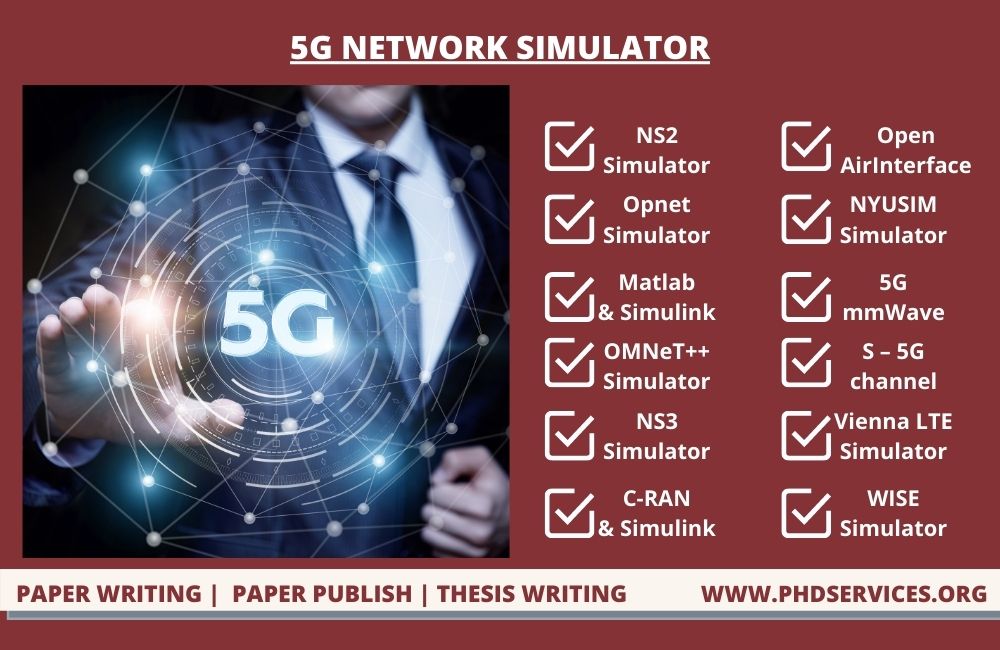
OTHER RELATED 5G SIMULATION TOOLS
In order to choose the best simulation tool for your 5G communication network project, you should first understand the working of different simulators so as to choose from among the simulators with different characteristics.
- C – RAN simulator
- The cloud services based on 5G network systems are simulated using this tool
- OpenAirInterface
- EURECOM partners sponsor this simulation tool
- 5G cellular networks development is based on this simulation (commercial off – the shelf hardware)
- NYUSIM
- It is used in the generation of temporal and spatial wideband thus; as a result response of the channel impulse is studied
- User-friendly interface
- Carrier frequency range from 2 and 73 gigahertz
- 5G mmWave
- It is the best simulation tool using NS3, where education and research are the major domains in which it is used
- S – 5G channel
- S – 5G channel is the next generation simulation tool
- It is one of the innovations carried out by recent researchers
- PyLayers
- It is an open-source simulator
- Py layers can be used to simulate particular radio channels that are specific to different areas of applications which include the following
- Mobile communication propagation
- Heterogeneous networks
- Wearable communication devices
- 5G MIMO
- Vienna LTE Simulator
- Large-scale 5G communication network simulation is possible using the Vienna LTE simulator
- It is oriented under multiple tiers
- The software coats are free to use which can be used to support parallelization of many nodes
- WISE
- It is a system-level 5G simulator
- WISE is a multi-tiered orientation tool
- Validating and simulation of 5G is possible using the available source code present in.
- RANPLAN
- RANPLAN stands for Radio Network Planning
- AR and VR like novel 5G services can be simulated using this tool
- It is helpful in the following
- Deployment of heterogeneous networks
- Deploying small cells in an ultra-dense model
- GTEC 5G SIMULATOR
- 5G link-level simulation
- Implementation of transceiver
You can get any kind of research support on all the above 5G simulation tools from our dedicated team of experts providing research support for 5G simulation projects. Other simulation tools have the following characteristics.
- Simulators with interfaces for open functioning
- Simultaneous transmission across different technologies that are accessible
- Supportive to heterogeneous networks
- The capability of transmission at mm wave frequencies
- Users scheduling techniques and AMC
Connect with us to know in detail about the working efficiency of different simulators, and then choose the best tool for your project. Let us now talk about the important requirements of a good 5G simulator.
MAJOR REQUIREMENTS OF 5G SIMULATORS
The conditions of the channel and the network traffic define the configuration of any network. The 5G nodes are included dynamically based on the above two aspects and the bit rate. So the first major requirement of the 5G simulator is its capability to act according to the dynamic nature of the network. The other essentials of a 5G simulation tool are listed below
- BS-MS channel link modeling
- Relay at the intermediate level (at D2D link)
- The vehicle to anything communicationshave to include the following
- QoS supportive
- Enhanced gain of the channels acting as relay nodes at the intermediate level for MSs
- Simulator embedded channel links are possible
- Maximizing the rate of data (using the MU – Massive MIMO techniques)– The complex post-processing methods that are highly efficient in computation using proper techniques for beamforming (accepted QoS provisions and separation of users are supported)
- 4G and 5G networks co-existingin the same area form the better infrastructure, which is heterogeneous. Quality of service parameters has to be preserved even when the network switches from one form to another.
- The features that are created and developed using the simulation codes for 5G should be verified universally. The flexibility and reusability of the simulation tool, which is also supportive to different real-time situations, are also needed
- The dynamic configuration of the 5G networks should involve the techniques of adaptive RRM. Optimization of various variables associated with the network functioning is complex to be determined. Based on the characteristics of the present link, the different link’s fronthaul ability decides the function split.
You can talk to our world-class certified developers and engineers regarding any technical doubts about different 5G simulation tools. We will solve your problems by giving practical examples and solutions to your questions instantly. Now let us have a quick look into different security threats that can take place in a 5G network simulation project.
SECURITY ATTACKS IN 5G NETWORK SIMULATIONS
Until now, we have seen that the channel has to be modeled by incorporating BS-MS link, relay nodes at the intermediate levels, v2x communication, and D2D link. In such a design, some threats can become potential while simulation. Before getting into detail about such security threats, we need to ponder upon the following aspects of the 5G network simulation
- Prediction of the following is possible by ns3 simulationof LTE networks
- Network performance
- 5G and advanced Behaviour of the network
- The graphical user interface, when integrated with ns3 network simulationtool, the following aspects should be considered
- Networks behavior, along with its formation, can be easily determined
- There is a possibility of different attacks as a result of the ns3 simulation tool used over mm-wave
In the case of networks with multiple nodes, the following are the major security threats that can arise. You can get the help of our research experts who gained enough experience in solving such issues
- Imitation of the mobile nodes and Sybil threats
- The nodes are replicated or are imitated so as to confuse the servers.Mm-wave ns3 simulation can be used to avoid such types of Sybil Threats in the future
- Attacks at the level of application
- The environment of the network is damaged by injection at the front end level
- Conventionally the packets are let into the network channels, and critical information is damaged
- Again mm-wave ns3 simulator libraries and code can be used to solve this problem by simulation
- Attacks like DDoS
- The package is distributed from sources which in turn will stall the 5G network functioning
- In that situation, mmwave ns3 simulator can be used to deploy a preventive algorithm that prevents such kind of attacks when a particular number of users are achieved in a network
From the points mentioned above, you should have now understood the infrastructure for the 5G simulation, which would need the following aspects to be fulfilled.
- Physical layer transmission aspects like protocols for accessing, massive MIMO, mm wave transmission
- Adaptive RRM algorithms for access control
- Services that demand new bandwidth
- Configuring the networks for a variety of elements
- a unified framework in the midst of inbuilt complexity
- The best simulation tool to handle all the above aspects of 5G network projects must be thus made as your choice.
We are updating ourselves regularly on all the latest breakthroughs that are recorded in the 5G infrastructure. We have also proposed better options for solutions in order to handle problems with different essentials in the 5G simulation. You should keep an eye on the network traffic and the metrics associated with analyzing the 5G networks’ performance to do the best research work. Reduction in execution time can be established only when parallelization norms are taken into consideration due to the complexity of the network itself.
The complications that arise in simulations due to the network complexity can be easily solved by our technical team of engineers, who will share with you their huge user experience in guiding 5G simulation projects. The application of 5G network simulation is a huge list which includes the following.
- Applications that show zero latency
- Autonomous vehicles
- Unmanned automatic vehicles configured for dynamic situations
High accuracy in representing the channels, better network design and orientations, and the apt simulation tool can be the only solution to solve research problems in 5G. You, as a researcher, need to understand the importance of it and make your project contribute an immensely important application to the above list. Our engineers are here to support you in all aspects of your research work using 5G Simulation Tools. So get in touch with us to get your entire project guided by world-class research experts.