







The Internet of Things (IoT) is a web-based interconnection of a large volume of smart devices/objects to create global information sharing. For this purpose, it includes resource-constrained IoT sensors, RFIDs, actuators, RSUs, and other smarts that can sense data from the real world dynamically. All these components are connected with one another to create communication between devices and devices to the environment.
From this page, you gain details on current developments in IoT Project Topics with their future research directions!!!
Due to the incredible demand for wireless communication, the IoT has increased usage in all modern day-to-day applications and services. In general, it has the objective to create an advanced society by linking several intelligent devices and technologies in one place. To sum up, it is launched to automate each and every activity around us in the environment.
Now, we can see about the system architecture of IoT applications which holds different layers and services for effective data sharing in both small and large networks. Below, we have listed the general architecture of IoT systems.
IoT Architecture
- Industrial / Normal Devices:
- Here, it is designed to automate the industrial operations with minimal human intervention. As a result, it offers the separate technology meant for industries as Industrial 4.0 / Industrial IoT
- For instances: smart supply chain maintenance, smart micro / macro grid, employee healthcare, IoV and many more
- Perception Layer:
- In this, various smart components / entities are interconnected with each other in the IoT network.
- IoT devices – tiny sensors, controllers, actuators, bar / QR code scanner, smart meters, RFID, and many more
- These connected components will monitor the surroundings and capture the data in the form of image, video, signal, text, etc.
- In specific, some devices immediately response to the environs
- Data Transfer Layer:
- Here, in order to establish the communication between the IoT devices, these devices are need to linked with micro / macro base station (BS) and access points (AP)
- Then, to make data transmission possible over the wired / wireless channel, include advance communication technologies / protocols. Some of them are listed below,
- Long Range (LoRa)
- Narrowband IoT (NB-IoT)
- Low Power Wide Area (LPWA)
- Sigfox and Ethernet
- WiFi, Bluetooth and Zigbee
- Highway Addressable Remote Transducer (HART)
- Near Field Communications (NFC)
- IPv6 over Low-power Wireless Personal Area Networks (6LoWPAN)
Next, we can see about the upcoming research issues in the internet of things field. These issues are listed based on our expert’s recommendation. Since these ideas are captured from our currently trending IoT Project Topics. Still, our research team is looking forward to framing up-to-date research notions by referring latest research articles.
Research Challenges of IoT Internet of Things
- Blockchain enabled IoT Security and Confidentiality
- Similarity based Data Aggregation and Node Localization
- Real-time Traffic Monitoring and Routing in IoT
- QoS Aware IoT Application using LPWA Technology
- Cluster based IoT Coverage and Mobility Management
- Custom based Query processing and Data Management
- Sensor Fault Identification and Low Power Data Integrity
- New Design of Medium Access Control (MAC) Protocol
- Optimal Prevention Mechanisms for IoT Traffic Congestion
- Technology for Heterogeneous IoT Device Interoperability
Similar to the research team, our development team is also passionate to work on current emerging research areas despite challenges. In order to cope with new technological advancements, our developers update their skills by practicing the following concepts to create innovative IoT Project Topics. So, we are ready to support any kind of IoT research.
Our Experts Skills in IoT Internet of Things
- Modelling of Real-time Systems Integration in Test bed
- Innovation in IoT System and Applications
- Execution of Improved Protocols and System Architecture
- Familiarity in Several Real-time Case Studies and Use-Cases
- Effective System Study and Performance Assessment
- Implementation of Real-time Embedded and Distributed Models
- Future Technologies of AI driven Computational Science
- Experimental Analysis of Realistic Prototype
- System Analysis: Trustworthiness, Security and Robustness
- Software and Hardware Requirement Measurements
- Development of New Algorithms, Testing Approaches and Prototype
- Emerging Supportive Communication Technologies and Operating Systems
- Management of Organized Network Components and Hardware
Next, we can see the few significant elements of the IoT system. By the by, it comprises supporting computational hardware/software, Addresses identification, communication technologies, semantic web system, smart sensors, and common IoT services.
Building Blocks and Technologies of IoT
IoT Components
- Computation
- Software
- Cloud enabled Platforms– Nimbits, Hadoop and many more
- Operating Systems – TinyOS, LiteOS, Android, Riot OS and ContikiOS
- Hardware
- Intel Galileo
- Arduino
- BeagleBone
- Phidgets
- Gadgeteer
- Cubieboard
- Smart Objects and Phones
- Raspberry Pi
- Software
- Recognition
- IP Address – Internet Protocol version 4 and 6
- Naming – uCode Electronic Product Code
- Wireless Communication Technologies
- WiFi and WiFiDirect
- Bluetooth Low-Energy (BLE)
- IEEE 802.15.4 Standard Protocol
- Radio-frequency identification (RFID)
- LTE-Advance Pro
- Ultra-wideband (UWB)
- Z-wave and Bluetooth Technologies
- Near Field Communication (NFC)
- Semantic
- Efficient XML Interchange (EXI)
- Resource Description Framework (RDF)
- Web Ontology Language (OWL)
- Smart Entities
- Embedded Devices
- Small Sensing Devices
- Radio-frequency identification (RFID) tag
- Actuators
- Wearable Sensors
- Service
- Data Accumulation (Smart Electrical Grid)
- Mobile Service Identity-oriented (Shipping)
- Ubiquitous Smart Cities Services
- Cooperative-Aware Service (Home Automation)
In the current and emerging IoT field, most of the applications incorporate al modern sensors, RFID, IP, and communication technologies. So, we make ourselves familiarized with all smart IoT technologies to support you in all respects. Here, we have listed out few commonly used operating systems for developing IoT project topics.
Common Operating Systems Used in IoT Environments
- Lite OS
- Multi-Threading Feature – Yes
- Supportive Language (s) – C
- Event-driven Paradigm– Yes
- Run-time Memory Usage – Yes
- Least Memory (KB) Capacity – 4
- Android
- Multi-Threading Feature – Yes
- Supportive Language (s) – Java
- Event-driven Paradigm– Yes
- Run-time Memory Usage – Yes
- Least Memory (KB) Capacity –
- Riot OS
- Multi-Threading Feature – Yes
- Supportive Language (s) – C / C++
- Event-driven Paradigm – No
- Run-time Memory Usage – Yes
- Least Memory (KB) Capacity – 1.5
- Tiny OS
- Multi-Threading Feature – Limited
- Supportive Language (s) – nesC
- Event-driven Paradigm– Yes
- Run-time Memory Usage – Yes
- Least Memory (KB) Capacity – 1
- Contiki OS
- Multi-Threading Feature – Yes
- Supportive Language (s) – C
- Event-driven Paradigm– Yes
- Run-time Memory Usage – Yes
- Least Memory (KB) Capacity – 2
Application Protocols used in IoT
- Extensible Messaging and Presence Protocol (XMPP)
- Data Distribution Service (DDS)
- Message Queuing Telemetry Transport (MQTT)
- MQTT for Sensor Networks (MQTT-SN)
- Constrained Application Protocol (CoAP)
- HTTP based Representational State Transfer (REST)
- Advanced Message Queuing Protocol (AMQP)
IoT System Protocols
- Link Layer
- IEEE 802.15.4 Standard
- Device or Physical Layer
- Electronic Product Code Global
- Z-Wave Scheme
- LTE Advanced (LTE-A)
- Network Layer
- IPv6 or IPv4
- Routing Layer
- Routing Protocol for Low-Power and Lossy Networks (RPL)
- IPv6 over Low-Power Wireless Personal Area Network (6LoWPAN)
- Service Discovery
- DNS Service Discovery (DNS-SD)
- multicast DNS (mDNS)
- Other Protocols
- IEEE 1905.1 Standard
- IP Security (IPSec)
- IEEE 1888.3 Standard
Next, we explained the list of available communication technologies in IoT applications and services. The communication technologies are classified based on the supportive coverage areas such as long-range, short-range, and medium-range interaction
IoT Communication Technologies
- Long-range Communication
- Very Small Aperture Terminal (VSAT)
- It employs small antennas for collecting broad / narrow band information in satellite networking
- Low-Power Wide-Area Networking (LPWAN)
- It supports smooth data transmission in maximum coverage area with an assurance of low power, cost and data rate.
- For instance: Narrowband-IoT, LoRaWan, RPMA, Sigfox and more
- Very Small Aperture Terminal (VSAT)
- Short-range Communication
- Radio-frequency identification (RFID)
- It utilizes electromagnetic waves to fetch the information and warehouse them in tags
- Bluetooth Mesh
- It is constructed in the form of mesh topology on using Bluetooth low energy (BLE).
- Further, it supports conventional application models and large-scale nodes
- Wi-Fi Communication
- It is the LAN based technique which operates by means of IEEE 802.11 protocol.
- Here, the devices can independently interact with other or uses access points
- Z-Wave Technology
- Well-suited for smart home and security related applications
- Light-Fidelity (Li-Fi) Communication
- It has similar characteristics of Wi-Fi technology.
- Also, it works on the principle of light based communication in order to achieve high bandwidth
- ZigBee Technology
- It is the PAN based techniques which operates by means of IEEE 802.15.4 protocol.
- By the by, it has the benefits of minimum ( cost, bit rate, and power usage) and maximum (throughput)
- Near-field communication (NFC)
- In the distance of 4 cm, it supports the communication among electrical hardware
- Radio-frequency identification (RFID)
- Medium-range Communication
- 5G Network
- Introduced to meet the end-to-end communication support which maximum needs of the IoT.
- Also, it facilitates to work with huge-scale devices in regardless of their moving nature
- LTE-Advanced (LTE-A)
- It is the upgraded version of LTE network which has ultra-speed message sharing in cellular networks.
- Moreover, it has advantage of low delay, prolonged LTE coverage and high throughput
- 5G Network
For your awareness, here we have given the real-world IoT applications which are based on proof-of-concept execution. Since most of the researches is proved by means of experimental modeling and analysis.
Real-Time Applications of IoT
- Load Balancing using Cloud-assisted Techniques
- Moving Object Trajectory Tracking and Assessment
- Information Centric Smart Cities Management
- Employment of Artificial Intelligence in Smart Environments
- Emergency Message Dissemination in Autonomous Vehicle
In addition, our developers have listed out few attention-grabbing IoT Project Topics. Beyond this, we also support you in other interesting research areas and concepts. Further, if you have your own idea to develop then we also help you in that too.
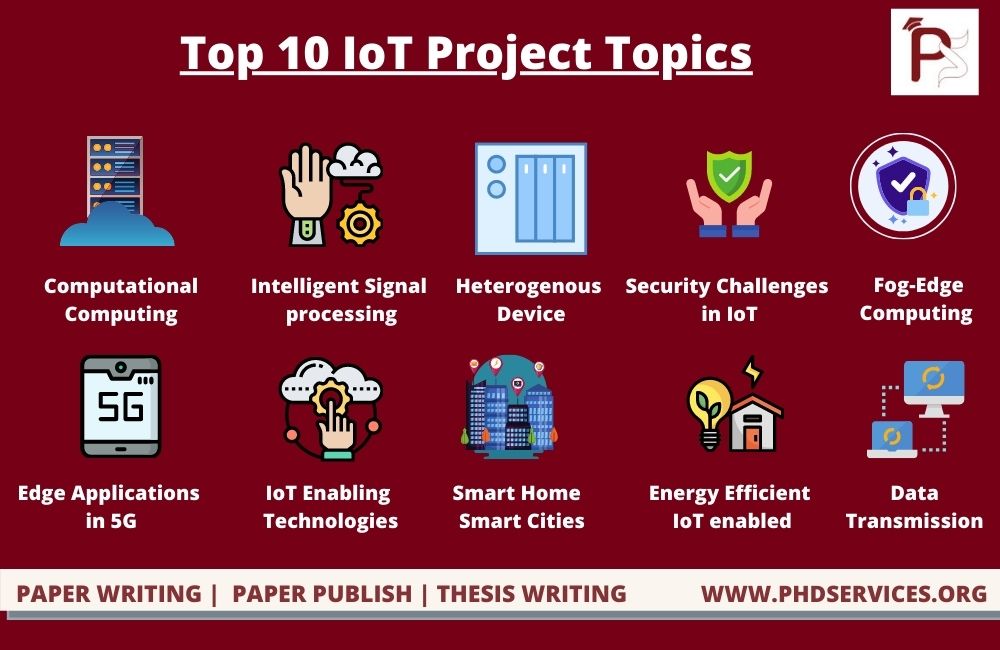
Top 10 Research Ideas for IoT Project Topics
- Performance Evaluation in Computational Computing
- Intelligent Signal processing in IoT Network
- Heterogenous Device and Network Connectivity
- New Privacy and Security Challenges in IoT
- CRN based IoT in Fog-Edge Computing
- Lightweight network-aware Edge Applications in 5G Network
- IoT Enabling Technologies in Business Community
- Trust based Innovative IoT Applications
- Smart IoT applications: Smart Home and Smart Cities
- Secure and Energy Efficient IoT enabled Fog-Edge System
- Environmental Scenario Analysis and Results Assessment
- Data Transmission Routing and Services in WSN-Ad Hoc
Next, we have given the widely used development tools and technologies for IoT project Topics. Based on the requirement of the project, we suggest you appropriate tool which sure to yield the best outcome in minimal effort. Reach us to know more about underwater wireless sensor networks challenges.

Implementation Tools for IoT Projects
- CubCarbon
- Supportive Network Size – Limited
- Enabled Language – Custom Scripts and Java
- IoTSim
- Supportive Network Size – Wide
- Enabled Language – Java
- OMNeT++
- Supportive Network Size – Wide
- Enabled Language – C++
- DPWSim
- Supportive Network Size – Limited
- Enabled Language – Java
- QualNet
- Supportive Network Size – Wide
- Enabled Language – C++ and C
- iFogSim
- Supportive Network Size – Unknown
- Enabled Language – Java
- Cooja
- Supportive Network Size – Limited
- Enabled Language – Java and C
- SimIoT
- Supportive Network Size – Limited
- Enabled Language – Java
- NS-3
- Supportive Network Size – Wide
- Enabled Language – C++
Future Research Directions in IoT
- Analysis of Huge Data in IoT assisted Biomedical applications
- Complications in Advance IoT System Development and Deployment
- Issues in Heterogeneous networks interoperability
- Employment of Blockchain for Critical IoT Security
- Standard Protocols for IoT Framework and Services
- Collaboration of Artificial Intelligence in Edge-IoT System
- Integrate Learning Techniques on Artificial Intelligence for Enhanced IoT
On the whole, we promise you that we will provide precisely give end-to-end service for your research and development in the domain of the internet of things. So, if you are interested to hold our service to choose interesting IoT Project Topics, then communicate with us.