






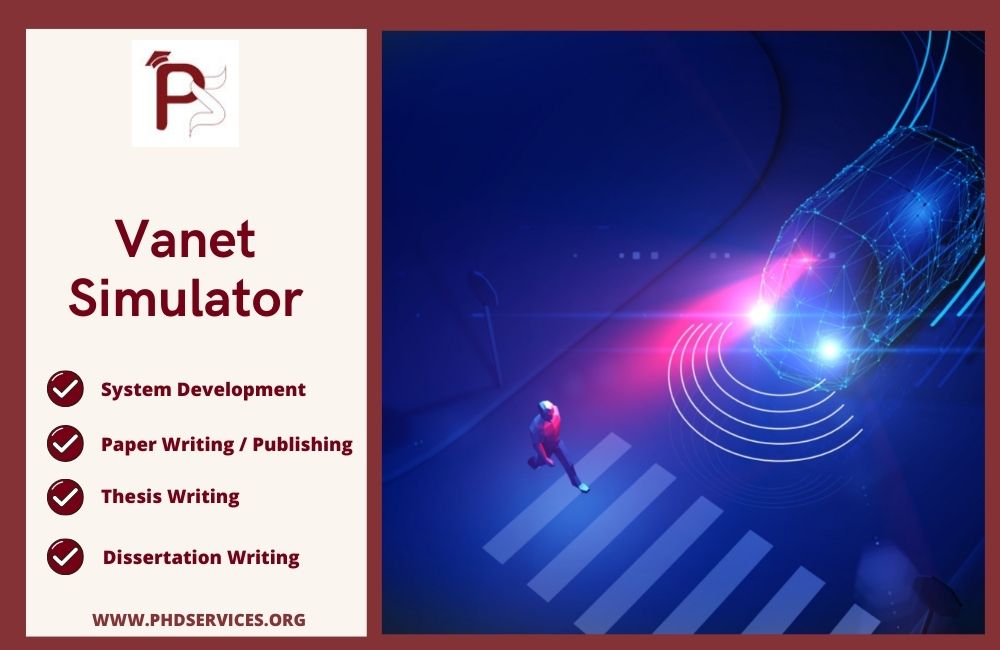
What is meant by VANETs communication? A vehicular ad hoc network (VANET) is a collection of groups of active or moving vehicles that are interlinked through a wireless network i.e. ROADSIDE UNITS (RSUs). Nowadays VANET is the only solution when we have a lack of telecommunication among vehicles. We are giving a better vision of the VANET simulator. The primary utilization of VANETs is to give wellbeing and comfort to drivers in traffic conditions.
Latest applications of VANET
VANET applications are categorized into four types which are presented below,
- Vehicle safety and security management services
- Individual motion control
- Group motion control
- General information services
We can separate the applications based on three categories:
- Traffic efficiency handling applications.
- Active road safety applications.
- Infotainment applications.
Wellbeing applications are subdivided into circumstance alerting applications and security informing applications. Non-wellbeing applications incorporate the applications for relief driving, upgrading the driving system, and traffic data frameworks. But it doesn’t show any information concerning life security.
What is the purpose of VANET?
The chance of empowering correspondence between vehicles through a remote organization animated the production of new conventions, gadgets, and different use situations. Because of the natural hardships of utilizing a genuine testbed to assess these examination commitments, a few Simulators were developed at that point. To test VANETs, simulators are the best choice because of the minimal price.
Nonetheless, test systems should have the option to display the clever innovations entering the VANETs space (e.g., SDN, edge computing, and 5G) and offer help for wellbeing and security instruments to be valuable and pass on solid outcomes.
Architecture of VANET
Vehicles taking part in VANETs are outfitted with a bunch of remote sensors and On-Board Units (OBUs). Those units permit remote correspondence between the vehicles and their current circumstance. These gadgets make every vehicle go about as a bundle sender, beneficiary, and switch. It empowers the vehicles to send and get messages to different vehicles RSUs inside their span utilizing the remote medium.
Different categories of VANET Simulator:
VANET are constructed from the benefits of both network and versatility simulators. Network simulators are answerable for displaying correspondence conventions and the transmission of messages, while versatility simulator systems are in charge of the development of every hub, i.e., its portability.
Some important VANET Simulators are,
- Veins
- EstiNet
- NetSim
Veins
Veins are a non-proprietary software framework utilized for running vehicular network simulations. It depends on OMNeT++ and SUMO. The simulator builds an OMNeT++ hub for every vehicle present in the simulation and afterward combines hub developments with developments of vehicles in the street traffic simulator (i.e., SUMO). For this situation, both the network and versatility simulations can run simultaneously. By the use of a normalized connection protocol, the Traffic Control Interface (TraCI) bidirectional coupling was carried out successfully.
TraCI empowers OMNeT++ and SUMO to transmit messages (e.g., containing portability follows) while the simulations run, as a component of TCP associations.
The simulator incorporates a huge number that permits displaying distinctive protocol stacks (e.g., IEEE 802.11p, ETSI ITS-G5) just as applications (e.g., vehicle platooning). Veins are intended to fill in as an execution environment for client-written projects, which works with displaying new conditions and applications.
EstiNet
EstiNet is a business network simulator and emulator with high time loyalty. It utilizes an inventive system, known as kernel re-entering, to join the benefits of both the simulation and emulation techniques. Fundamentally, the approach utilizes tunnel network interfaces to consequently capture the packets transferred by two genuine applications and divert them to the simulation engine of EstiNet.
Prime components of EstiNet
VANET Simulator acts as a voluntary module plug-in to EstiNet. To mimic vehicular traffic, EstiNet upholds a street building capacity, in which a road network can be worked without any preparation or by bringing from a roadmap file.
EstiNet has own portability simulator that considers essential vehicle and human driving conduct, for example, vehicle follow-up, path evolving, surpassing, and consistency with traffic signal signs. Concerning the protocol conventions, IEEE 802.11p, IEEE 1609.3, and IEEE 1609.4 are upheld by EstiNet.
The main use of EstiNet is to present the OBU and RSU abstractions in VANET simulation. To mimic OBUs, EstiNet supplies distinctive OBU correspondence interfaces. Every communication interface addresses a particular communication behavior, for example, agent-based vehicles (IEEE 802.11p/1609) and module-based vehicles (IEEE 802.11p).
NetSim
NetSim is a business discrete occasion simulator that covers a wide scope of wired, remote, portable, and sensor organizations. The simulator offers three sorts of licenses: pro, standard, and academic, where just the initial two offer help for VANET simulations. To simulate VANETs, Netsim interfaces with SUMO are needed.
The previous handles the WAVE standard for remote correspondence between vehicles, while the last deals with displaying street traffic conditions. NetSim gives a bunch of execution measurements, connection links, and application throughput plots. Measurements will shift contingent on the sort of network simulated. Utilizing packet trace and event trace, clients can log details of every bundle, as it streams in the network. In NetSim engineering, each kind of network compares to a part of the vanet simulator with its particular protocols conventions.
Modules for NetSim
Inside Netsim VANET modules, one of them worth observing is RF Propagation Modules. This module incorporates Path Loss, Shadowing Model, and Fading Model, which are fundamental to foresee the sign misfortune or sign experiences inside a structure or thickly populated regions over distance.
This module helps with making the simulation more reasonable, as in a genuine situation VANET will doubtlessly experience numerous snags (e.g., structures, substantial traffic) for its signal correspondence.
It permits adding new parts to meet the client’s requirements and the presence of new advances. Advances like W-LAN, intellectual radio, MANET, LTE, IoT, VANET, Software Defined Networking (SDN), and satellite communications have been carried out on the simulator throughout the long term.
VANET RESEARCH TOPICS
- Guaranteed Tree-based Authentication system to Secure V2V and V2I Communications in VANETs
- Improving privacy in VANET using Distributed Blockchain-Based PKI (BCPKI) architecture
- Integration of Adaptive Topology Control to build Coordination Game Theory-Based Hybrid VLC/RF VANET
- An Effective Next-Hop Selection Strategy to interconnect Multi-hop VANETs
- Efficient VANET’s Health Monitoring system through Weighted Geographical Routing in Urban Traffic.
We offer ourselves several other attributes in our thesis writing service, which is enough to us the best sponsoring service provider in the world and the testimonies we receive from the students to say that.
Why Choose Us?
The vital factors that show ourselves is the best are presented below,
- More than 1000 technical experts with Ph.D. Grade and professional experience in the academic side who are always ready to assist students at any time for vanet simulator projects.
- Quality assignments and plagiarism-free dissertations are supplied because we adhere to a strict non-plagiarism policy.
- Timely completion of assignments and dissertation writing is guaranteed by a huge team of specialists at our disposal.
- Industry-leading 24/7 customer service as we don’t want any student to miss out on dissertation writing service and always get higher grades