







Finger vein recognition denotes a novel technique that is completely based on the analysis of physiological characteristics to work through biometrics. The pattern of veins from the palmer side of the finger is used as identification and is then analyzed for performing the authentication in a later period. This article on Finger vein recognition with anatomy Structure Analysis talks about all the aspects necessary for finger vein recognition research and system development.
Let us first start with the description of different methods used in finger vein pattern extraction
FINGER VEIN PATTERN EXTRACTION METHODS
The methods of light reflection and light transmission are used for the extraction of patterns in the finger vein.
- Light Transmission
- In the light transmission method, disorders of light and image sensors are placed on either side of the finger
- Near-infrared light is used for capturing the finger vein patterns by passing it through the fingers
- In turn the image sensor captures the near-infrared light that reaches it
- Light Reflection
- In the light reflection method, the Source of light and sensor for the opening image is located on the same side
- Image sensor is used in capturing the light reflected from the finger surface
Is vein recognition biometrics reliable? Yes. At finger vein recognition with anatomy structure analysis, we not only provide technical explanations regarding the working of fingerprint scanners but also give you expert answers to the most important frequently asked questions in the field. In this regard we want you to consider the following points to understand the reliability of finger vein recognition
- Features of the veins in the fingers are preferred for the reason that they cannot be altered through any surgical operations.
- Hence vein recognition is considered to be one of the most trusted methods for authentication.
Since finger vein recognition has become the promising method of ensuring security in many systems, understanding all its processes play a very significant role. Accordingly, the process involved in extracting required objects from the finger vein images is important.

What is vein object extraction?
- Vein object extraction is the first step in finger vein recognition system
- Obtaining vein ridges is the significant function for which this process is carried out
- The performance of this recognition is a function of the finger vein anatomical structure
- The quality of the finger vein recognition system can be expanded by integrating the patterns associated with the veins and non-vein characteristics
It is crucial to note that the palmar side of the finger extends between fingertip and finger root as a result of which a network of two to three core veins and their associated branches over the two-finger boundaries is formed.
If you wish to dig deep into the science behind vein recognition then you can get in touch with us and gain access to collections of thousands of reliable books, standard references, and benchmark sources related to finger vein recognition. We also provide you with the most needed explanations for your project.
Let us now discuss the anatomical structures and their features for the purpose of finger vein recognition
Anatomy structure features for Finger Vein Recognition
On talking about the anatomy-based features that make finger vein recognition system highly relevant is the following,
- Vein continuity
- The pattern of veins which starts from the of the finger continuously featured until its foot
- That is the vein pattern is regular and continuous which is not broken in the middle
- Also interconnection is established in every branch as well as among various branches
- Solidity and smoothness
- Every vein pattern branch is a solid curve and is also smooth
- Sudden and Cutting alterations in the vein width are not encountered
- Vein pattern is also observed in a well-structured manner without holes and burr
- Directional pattern
- The vein branch pattern is observed as parallels to the fingers
- Any other branches apart from the main one are seen at arbitrary angles
- Orientation of vein growth is seen as a dynamic parameter in all vein branches
- Variation in width
- Vein patterns’ outer diameter is dynamic where coarse variations are observed as we move from finger root to tip as well as along core to sub-branch
- The proximal outer vein branch diameter and finger middle segment difference is determined
- When the Vein position is at the proximal finger segment, the diameter is determined as a range between 0.68 and 0.88 millimeter
- Whereas at the middle finger segment, the diameter is observed to be ranging from 0.52 to 0.76 millimeter
These are the major characteristic features of the fingerprints structures. The advancements of technology allow us to acquire and access digital data all around the world while it has become a difficult undertaking to maintain good security and data secrecy. On par with all the latest trends and developments, we focus on updating ourselves regularly so as to go with present and future demand in finger vein recognition research.
We created a number of finger vein pattern-based witnessing technologies that are being used on a real-time basis. Check out our website for the list of our successful finger vein recognition with anatomy Structure Analysis projects. Let us now talk more about the imaging characteristics of finger vein
Finger Vein Imaging Characteristics
- Near-infrared light energy is absorbed heavily by hemoglobin inside the veins while acquiring images but it can readily pass through other tissues inside the fingers, resulting in a vein pattern with lower gray levels when compared with the non-vein regions in the acquired image patterns.
- As a result, every vein pattern’s cross-sectional outline seems to have a valley form.
- Yet, it is discovered that perhaps the valley-shaped (half) and cross-sectional characteristic of the vein pattern actually occurs in moderate photos after a thorough examination of the finger vein images.
The algorithms and functions involved in digital data security by unique Identity verification are available for reference on our website. Our engineers have used appropriate platforms and software for filtration, augmenting, fragmenting, extraction of features, deep learning, and categorizing the finger vein image.
We are well aware of the processes, components, and algorithms needed for finger vein recognition techniques to be done in all these stages. We have also found potential solutions to the research issues in finger vein anatomy. What are the issues in finger vein anatomy structure?
Finger Vein Anatomy Structure Issues and Solutions
- Noise
- The association of valley shaped cross-sectional profile with non vein point is the reason for the noise
- The characteristics of smooth nurse and continuity are found unmatched in this anatomical structure
- Solution – Denoising is the method used for processing noise
- Breakpoint
- The blurring of vein pattern leads to the formation of breakpoints
- Continuity mismatches cause breakpoints to occur
- Solution – Connecting methods are involved in processing breakpoints
- Hole
- The inaccurate orientation of the veins lead to the formation of holes
- The anatomical feature of solidness is the unmatched component leading to holes
- Solution – Filling methods are used for processing holes
Since our technical team has experience of more than 15 years of finger vein image-based projects, we have devised ideal alternatives to all such problems. Also with the improvements in the field of health informatics and life and medical sciences, the demands on finger vein recognition technology are also increasing. We have been able to provide high-quality project support including both technical and literary aspects like writing thesis and proposals in finger vein recognition mainly because of the arduous efforts of our experts. We gained expertise in finger vein pattern Denoising about which we have discussed below
Denoising in Finger Vein Patterns
- Inside a thinned pattern of veins, there seem to be two types of noise
- Isolated noise within the non-vein portion
- Roughness just on vein pattern.
- The regions among all linked areas inside this binary finger vein images are assessed for solitary noise, and any interconnected domains including an area much less than the actual size level are considered as isolated turbulence or noise and are eliminated.
For further details on Denoising processes, you can contact us. In relation to security and efficiency, the finger vein has more potential than conventional biometric technology. So you need to have a complete idea of all its processes, especially denoising.
Nonetheless, depending on the processor’s capability or the environment in which it operates, precision (accuracy) may well be compromised. We proposed many advanced approaches for improving finger vein recognition systems. Also quite importantly, the methods used in pattern recognition also play a primary role in its efficiency. So we will look into the non-vein and vein based recognition methods below
Finger vein vs. Non-vein recognition methods
- Methods for vein pattern recognition
- Region growth and Gabor filters
- Mean curvature and maximum curvature point
- Repeated line tracking, wide line detector, and proposed method
- Methods for non – vein pattern recognition
- LLBP and (2D) PCA
- Super – pixel-based feature and Minutiae
- DBC and LBP
Both of these methods involve several techniques and approaches for acquiring finger vein images, Pre-processing them, and analyzing. When compared to other hand-based biometric technologies, a finger vein-based biometric system has various advantages.
What are the advantages of finger vein recognition? As the finger vein pattern is indeed an anatomical trait, it is difficult to duplicate, and also finger vein recognition doesn’t really necessitate finger-sensor touch, which is advantageous from a cleanliness standpoint. In order to get such crisp technical notes on finger vein recognition with anatomy structure analysis, which are both reliable and updated you can reach out to us at any time. Let us now see about certain approaches in finger vein recognition,
Popularly Used Finger Vein Recognition Approaches
- Principal component analysis
- The following are the different aspects of principal component analysis
- Two-dimensional principal component analysis (or 2DPCA)
- Linear discriminant analysis (or LDA)
- Two directional and two-dimensional principal component analysis
- Transformation Matrix training requires additional practical application-based data
- Superpixel based feature
- In this approach even though the rate of recognition is very high the process itself is highly time-consuming
- The value or parameter based uncertainty makes the Recognition rate reproduction hard
- Scale-invariant feature transform
- Finger vein images consist of the limited amount of minutiae
- Performance of recognition is therefore not up to the mark
- The formation of veins and finger displacement lead to difficulty in performing minutia and key point pairing
- High-level features
- The following are certain examples of high-level features which are used in finger vein recognition
- Vein textons map
- Personalized features
- Super pixel-based feature
- Hyper information feature
- Local binary pattern
- The following are the different aspects of the local binary pattern method of finger vein recognition
- Local line binary pattern
- Discriminative binary codes
- Effective local binary pattern
- The sparse texture of the images of finger vein can be obtained while using such binary features
- The ability of discrimination is diminished which in turn might lead to reduced performance efficiency
- Other methods
- Method based on neighborhood region – Wide line detector and Gabor filters
- Methods based on cross-sectional profiles – Region growth, Maximum curvature point, and Repeated line tracking
The binary coding and essential mathematical backing regarding these approaches will be provided by our experts to you in order to implement the finger vein recognition system. We stand with you at all stages of your project development and execution in real-time.
Complete prototype of the project, its proposal along with all your demands incorporated will be an original version designed by our experts with zero plagiarism. So you can depend on us with greater confidence. We shall now look into the working of finger vein recognition with anatomy structure
How does finger vein recognition works using anatomy structure?
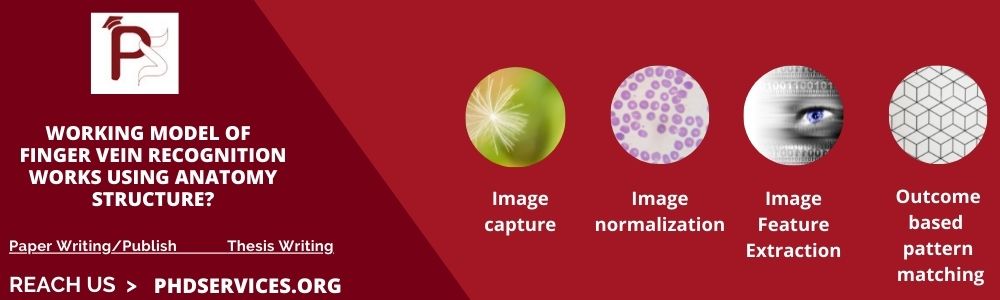
The following are the four major tasks that are executed by the finger vein recognition system
- Image capture (here image refers to finger vein pattern)
- Image normalization
- Image feature extraction (pattern)
- Outcome-based pattern matching
Generally, we explain all the fundamentals and advance the mechanism is in finger vein recognition system working. Our framework is focused on a common spatial pattern-based technique, with the best bits being used just for pattern matching purposes. So contact our experts and share your novel ideas.
First, we’ll go through your basic demands and help you in generating algorithms. The finger vein recognition architecture, which includes pre-processing, extraction and classification, and comparing, is then proposed. Finally, we devise a series of tests to assess the efficacy of the idea. Utilize our services in order to obtain highly successful project results in finger vein recognition. Let us now look into some of the most popular finger vein recognition datasets
Famous Datasets for Finger Vein Recognition
- SDU Database
- This dataset consists of around six hundred and thirty fingers of about twelve images each
- The images within this dataset have a configuration of 310 x 250 pixels and BMP files of 8 – bit gray level
- Segmentation of the finger region is carried out using proper pre-processing techniques
- HKPU database
The composition of this dataset is about three hundred fingers amounting to about three thousand one hundred images of finger veins
- The resolutions of these images are about 510 x 250 pixels contained in BMP files of 8 – bit gray level configuration
- With about twelve images in the first two hundred and ten fingers, the rest of the input consists of six images
- Image pre-processing labels are also a part of this dataset where they can be found in every finger region
Our projects using these datasets have shown a high level of reliability and durability. The results of almost all of our experiments have outperformed so many research challenges in finger vein pattern recognition. Advanced theoretical explanations and practical demonstrations are given by our experts on all concepts and mechanisms for your finger vein recognition with anatomy Structure Analysis project. Reach out to us for successful on-time finger vein and fingerprint recognition thesis completion.