
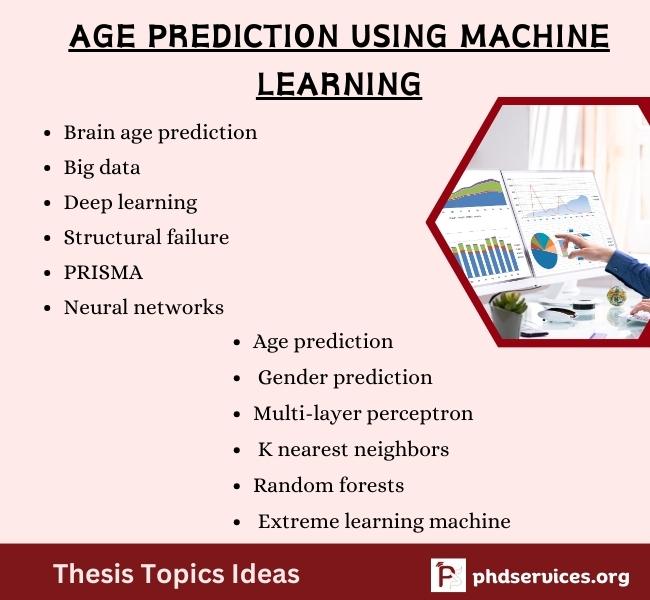
Some of the interesting thesis topics that we have worked are listed below, have a look at it and get
inspired. Contact us if you are in need of world’s best thesis experts’ solution. Customized thesis service along with a clear description is also possible.
Keywords
Brain age prediction, machine learning, multi-modality MRI, UK Biobank
A various ML methods like Lasso, relevance vector regression, SVR, XGBoost, category boost, and MLP are examined in our article to forecast middle and older aged person’s brain age. We illustrate that, brain age forecasting related to multi-modality improves the efficiency of model when compared with unimodality. Result shows the significance of image modality selection and considered Lasso as an efficient ML approach.
Keywords
Aging, epigenetic clock, vascular risk factors, stroke
A major goal of our paper is to discover an innovative approach to forecast the Age-A and to evaluate the offerings of quantitative attributes to Age-A in cerebrovascular disease patients by utilizing several ML techniques. By utilizing Hannum’s epigenetic clock, we evaluated Age-A. We trained various methods like traditional LR, EN, KNN, RF, SVM and MLP for AGE-A prediction. At last, EN and MLP provides greater end results.
Keywords
Classification, HD-sEMG
To forecast the active aging via motor functional age (MFA) evaluation, the ML based framework is suggested in our approach by utilizing HD-sEMG signals and retrieved features. We examined and integrated various time and frequency characteristics with ML methods. For active subjects, MFA must be similar or equal to Chronological Age (CA). We trained the methods using various datasets to examine the results.
Keywords
Mathematical modeling, literature review, artificial intelligence, mathematics, deep learning, big data, XAI, mechanical engineering, structural failure, materials, structural health monitoring, service life, prediction, PRISMA
Our article describes the efficiency and evaluation of aging process categorization and mathematical modeling. We illustrated the significance and adaption of several ML techniques such as DL, DT, CNN, SVM, regression analysis, and ANN which assist to enhance the modeling of aging process performance. We carried out the comparative analysis of various ML techniques. A prediction analysis framework by ML methods ease the difficult mathematical equations illustrates the physical aspect of structural aging.
Keywords
Neural networks, Abalone, Back propagation neural networks
To predict the Abalone age, we employed several ML methodologies in our research. ML approaches such as backpropagation feed-forward neural network (BPFFNN), K-Nearest Neighbors (KNN), Naive Bayes, Decision Tree, Random Forest, Gauss Naive Bayes, and Support Vector Machine (SVM) are compared for the forecasting of abalone age. We examined various optimizers with BPFFNN to estimate their impact on its performance.
Keywords
Age, Pupil size, Pupil diameter, Feature extraction, CNN, Geometric features
For the forecasting of human age through the utilization of iris, our study provides a brief description of various methodologies and techniques employed by the investigator. We reviewed several research papers by considering various procedures such as image segmentation, feature extraction and categorization of the iris. An effective prediction is carried out in our study by utilizing iris based current techniques.
Keywords
Twitter dataset, Author profiling, NLP, Age prediction, Gender prediction, TF-IDF
For author profiling, we employed natural language processing (NLP) and ML techniques in our article. We combined the NLP methodologies such as Tokenization, lemmatization, word and char n-grams with ML techniques including logistic regression (LR), random forest (RF), Decision tree (DT) and support vector machine (SVM). As a result, SVM technique offers better efficiency than other techniques in age and gender prediction.
Keywords
Multi-layer perceptron, K nearest neighbors, Random forests, Extreme learning machine
A multi class categorization issue named Abalone age prediction is carried out in our research by utilizing Abalone dataset. Here we utilized one of the randomization methods named Extreme Learning Machine (ELM) which utilizes the concept of least square estimation. As a consequence, we compared the efficiency of ELM and various traditional ML techniques such as MLP, KNN and random forests.
Keywords
Brain complexity, explainable AI, fractal dimension, SHAP
To evaluate the real generalization capabilities of the explanation, we suggested an approach that acquires the SHAP values inside the repeated nested cross-validation process. We forecast the person’s age by employing this approach utilizing brain complexity characteristics through MRI pictures. A SHAP values states that the newly executed FD has the greatest effect on others and considered as top level features for age prediction.
Keywords
CoVID-19 death’s age prediction, Feature selection, AdaBoost
A major objective of our study is to forecast the age of mortality in India’s Covid-19 environment. We employed several ML approaches such as AdaBoost and Random Forest. To enhance the training speed, we carried out the feature selection procedure by utilizing random selection, PCA, SVD, and correlation. As a consequence, AdaBoost provides greater efficiency in age forecasting process.