
Exploring the details of network protocols, structure and functions could become an exciting task when developing a project about a Python network simulator. We suggest you a list of different project topics and strategies which can offer a setting as well as an educational practice of your technical expertise:
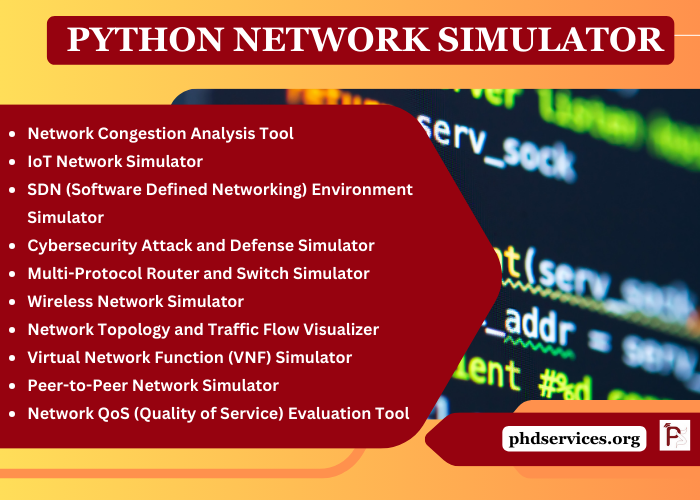
Including a variety of gadgets like smart devices, cameras and sensors, develop a simulator which creates an Internet of Things (IoT) platform. To examine their strength and trustworthiness in an IoT environment, apply and experiment multiple interaction protocols like CoAP, MQTT and others.
It is essential to design a tool which observes how congestion is controlled by various protocols like UDP and TCP and then simulates several network criteria. Under many congestion settings, you can visualize latency, throughput and packet loss using this plan.
By permitting you to test with configuration, network programmability and controller ideas, build a project which simulates an SDN platform. It consists of validating the reaction of various SDN controllers and simulating network alterations on the fly.
This project can assist in interpreting the efficiency of multiple safety plans. Specifically for cybersecurity training which contains several protection systems like intrusion detection models and firewalls and also some threat situations like Man in the Middle, DDoS and others, construct a robust simulator.
For assisting different protocols like BGP, OSPF and RIP, simulate the process of switches and routers. The influence of routing on network efficacy, the route finding and the routing approaches can be discovered here.
To assess QoS parameters such as packet prioritization, delay and jitter, develop a device which simulates different network situations. For serving challenging applications which need high QoS stages, it can assist in developing networks.
By designing features like mobility, interventions and signal capacity, develop a simulator which aims at wireless networks. It can simulate various wireless techniques like Wi-Fi, 5G and LTE and also in city and village ecosystems.
Simulate traffic flow using the networks by developing a tool which prepares and visualizes various network topologies like star, ring and mesh. In analyzing how the authenticity and efficiency are impacted by the topology, it is very useful.
In a network, simulate the process and deployment of VNFs. Along with efficiency, flexibility and scalability, it can discover the advantages and problems of network function virtualization.
Interpret the process of file transferring, broadcasting and dispersed computing by creating a simulator for P2P networks. Simulating the influence of network scalability, data redundancy and peer churn can be involved in this project.
What big networking or cyber security projects can I do using python?
According to your expertise and passion, you can do a lot of projects by implementing Python for both the research and educational purposes. In the cybersecurity, data analysis and network programming fields, we provide a wide range of interesting project strategies which utilize the huge library environment of Python and its abilities.
Through blockchain technology, apply a safe interaction protocol. For confirming privacy and reliability, it includes developing a distributed network in which messages are encoded and transactions are recorded on a blockchain. Specifically for verification tasks and autonomous trust, this project can discover theories like digital agreements.
For detecting and notifying on possible attacks, observe network traffic practically by constructing the latest intrusion detection system (IDS) which utilizes machine learning methods. To identify malware, abnormalities and different threat vectors in terms of previous data, it can contain the creation of frameworks.
To offer real-world knowledge within network efficiency and safety metrics, construct an extensive dashboard. Show metrics such as compliance status, device health, threat designs and traffic flow by implementing data visualization libraries and using Python for collecting data from several sources like firewalls, switches and routers.
Implement the aspects like encoded interaction, abnormality identification and device verification and create a model for protecting IoT devices and networks. To separate convinced devices and neglect sidewise action of attacks, this plan can also discover the application of micro-segmentation.
For penetration testing training and exploration, establish a virtual lab platform. Create scripts for automating penetration testing processes and reporting by utilizing Python to automate the deployment of virtual machines including several operating systems and vulnerabilities.
To collect, observe and perform on cyber threat intelligence from different sources, develop an environment which employs artificial intelligence. It could include automation to update protection mechanisms with novel threat data, machine learning to find directions and abnormalities and natural language processing to analyze attack documents.
Through different network applications and devices, construct a model which gathers, observes, and normalizes logs. To detect figures that denote functional problems or safety events, employ Python for data enrichment, the application of machine learning and log parsing.
Evaluate and handle the safety posture of cloud platforms by developing a tool. To suggest safe improvements on the basis of great procedure, identify misconfigurations and check configurations, this project can include interfacing with cloud supplier APIs.
For possible cybersecurity investigation motives, incorporate an environment which permits privacy-preserving and safe data transferring. By confirming that vulnerable details are secured, it would consist of methods like secure multi-party computation, data anonymization and differential privacy.
To identify and secure against phishing threats, create a model that uses web scraping and machine learning. Notifying users or blocking access to malicious sites, tracking web pages for phishing pointers and observing email content can be included in it.