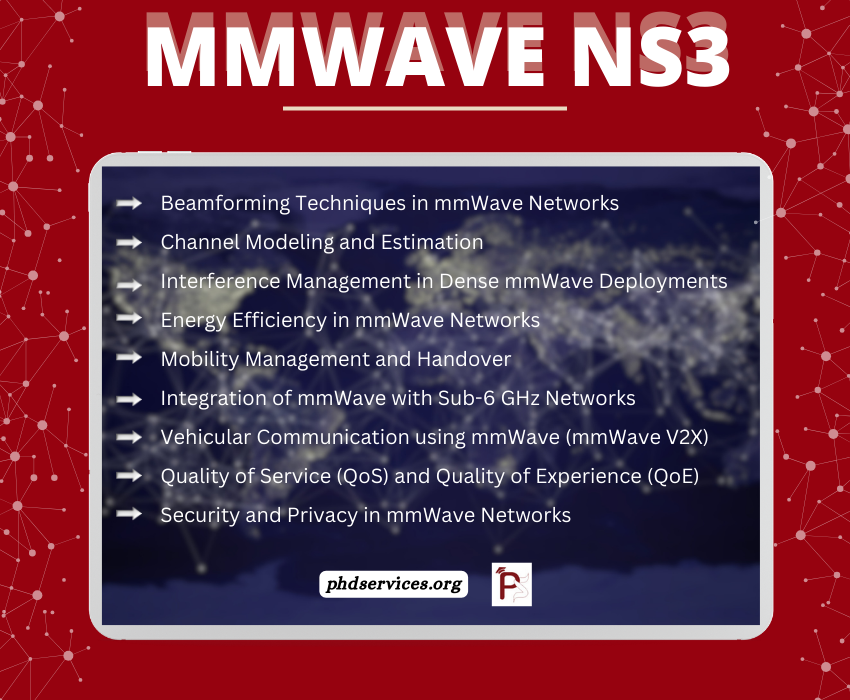

In mmWave technology, there are several research topics and ideas emerging continuously. We work on all areas of mmWAVE NS3 be free to address us all your doubts and get guidance from world’s leading writers by discussing with our team all your queries get valued insights for your work. To research mmWave mechanisms, the following are few progressive research topics and plans:
Research Topic:
Plans:
Research Topic:
Plans:
Research Topic:
Plans:
Research Topic:
Plans:
Research Topic:
Plans:
Research Topic:
Plans:
Research Topic:
Plans:
Research Topic:
Plans:
Research Topic:
Plans:
Instance Implementation in ns-3
You can utilize the mmWave module constructed by the NYU Wireless forum to deploy and simulate these research topics in ns-3. For simulating mmWave interaction, this module offers beneficial tools and frameworks. The following is a simple instance of how to configure an mmWave simulation in ns-3:
#include “ns3/core-module.h”
#include “ns3/network-module.h”
#include “ns3/internet-module.h”
#include “ns3/point-to-point-module.h”
#include “ns3/mobility-module.h”
#include “ns3/mmwave-module.h”
using namespace ns3;
int main(int argc, char *argv[])
{
// Set up default simulation parameters
double simTime = 10.0;
uint16_t numberOfNodes = 2;
// Create nodes
NodeContainer nodes; nodes.Create(numberOfNodes);
// Set up mobility model
MobilityHelper mobility; mobility.SetMobilityModel(“ns3::ConstantPositionMobilityModel”);
mobility.Install(nodes);
// Set up mmWave devices and channel
mmwave::MmWaveHelper mmWaveHelper;
NetDeviceContainer devices = mmWaveHelper.InstallEnbUeDevice(nodes);
// Set up the Internet stack
InternetStackHelper internet;
internet.Install(nodes);
// Assign IP addresses
Ipv4AddressHelper ipv4;
ipv4.SetBase(“10.1.1.0”, “255.255.255.0”);
Ipv4InterfaceContainer interfaces = ipv4.Assign(devices);
// Set up applications
uint16_t port = 50000;
OnOffHelper onOffHelper(“ns3::UdpSocketFactory”, InetSocketAddress(interfaces.GetAddress(1), port)); onOffHelper.SetConstantRate(DataRate(“100Mbps”));
ApplicationContainer apps = onOffHelper.Install(nodes.Get(0));
apps.Start(Seconds(1.0)); apps.Stop(Seconds(simTime));
PacketSinkHelper packetSinkHelper(“ns3::UdpSocketFactory”, InetSocketAddress(Ipv4Address::GetAny(), port));
apps = packetSinkHelper.Install(nodes.Get(1));
apps.Start(Seconds(1.0)); apps.Stop(Seconds(simTime));
// Run the simulation Simulator::Stop(Seconds(simTime));
Simulator::Run();
Simulator::Destroy();
return 0;
}
./waf –run your_simulation_script
How to simulate mmWave research work using ns3?
Numerous procedures should be adhered to configure your simulation platform, describe the network topology, arrange metrics, and examine the outcomes, when simulating mmWave research works with ns-3. We provide an extensive instruction that assist you to initiate the mmWave simulations in ns-3:
Step 1: Install ns-3 and the mmWave Module
Initially, together with the mmWave module, you must have ns-3 installed. As described below, you can copy the warehouse and develop ns-3 with the mmWave module:
git clone https://gitlab.com/nsnam/ns-3-allinone.git
cd ns-3-allinone
./download.py
git clone https://github.com/signetlabdei/mmwave.git
./build.py –enable-examples –enable-tests
Step 2: Set Up Your Simulation Script
To explain your mmWave network metrics and setting, construct a novel simulation script or alter a previous script.
Instance Simulation Script
The following is a simple instance of simulation script in C++ that arranges a basic mmWave network through the utilization of the mmWave module:
#include “ns3/core-module.h”
#include “ns3/network-module.h”
#include “ns3/internet-module.h”
#include “ns3/point-to-point-module.h”
#include “ns3/mobility-module.h”
#include “ns3/applications-module.h”
#include “ns3/mmwave-helper.h”
#include “ns3/mmwave-module.h”
using namespace ns3;
int main(int argc, char *argv[])
{
// LogComponentEnable (“MmWaveExample”, LOG_LEVEL_INFO);
// Set simulation parameters
double simTime = 10.0;
uint16_t numUeNodes = 2;
uint16_t numEnbNodes = 1;
// Create nodes
NodeContainer ueNodes;
ueNodes.Create(numUeNodes);
NodeContainer enbNodes; enbNodes.Create(numEnbNodes);
// Set up the mobility model
MobilityHelper mobility; mobility.SetMobilityModel(“ns3::ConstantPositionMobilityModel”);
mobility.Install(ueNodes);
mobility.Install(enbNodes);
// Set up the mmWave helper
Ptr<MmWaveHelper> mmwaveHelper = CreateObject<MmWaveHelper>();
mmwaveHelper->SetSchedulerType(“ns3::MmWaveFlexTtiMaxWeightMacScheduler”);
// Install mmWave devices on the nodes
NetDeviceContainer enbDevices = mmwaveHelper->InstallEnbDevice(enbNodes);
NetDeviceContainer ueDevices = mmwaveHelper->InstallUeDevice(ueNodes);
// Attach the UEs to the eNB
mmwaveHelper->AttachToClosestEnb(ueDevices, enbDevices);
// Set up the Internet stack
InternetStackHelper internet;
internet.Install(ueNodes);
internet.Install(enbNodes);
// Assign IP addresses
Ipv4AddressHelper ipv4;
ipv4.SetBase(“7.0.0.0”, “255.0.0.0”);
Ipv4InterfaceContainer enbIpIfaces = ipv4.Assign(enbDevices);
Ipv4InterfaceContainer ueIpIfaces = ipv4.Assign(ueDevices);
// Set up applications
uint16_t dlPort = 1234;
uint16_t ulPort = 2000;
OnOffHelper dlClientHelper(“ns3::UdpSocketFactory”, InetSocketAddress(ueIpIfaces.GetAddress(0), dlPort)); dlClientHelper.SetConstantRate(DataRate(“100Mbps”));
ApplicationContainer clientApps = dlClientHelper.Install(enbNodes.Get(0)); clientApps.Start(Seconds(1.0)); clientApps.Stop(Seconds(simTime));
PacketSinkHelper dlPacketSinkHelper(“ns3::UdpSocketFactory”, InetSocketAddress(Ipv4Address::GetAny(), dlPort));
ApplicationContainer serverApps = dlPacketSinkHelper.Install(ueNodes.Get(0)); serverApps.Start(Seconds(1.0)); serverApps.Stop(Seconds(simTime));
// Run the simulation
Simulator::Stop(Seconds(simTime));
Simulator::Run();
Simulator::Destroy();
return 0;
}
Step 3: Build and Run the Simulation
./waf
./waf –run scratch/mmwave-example
./waf
./waf –run scratch/mmwave-example
Step 4: Analyze the Results
To assess the effectiveness of your mmWave network, you can explore the output data after executing the simulation. In order to record network parameters like packet loss, throughput, and latency, ns-3 offers different tracing technologies.
AsciiTraceHelper asciiTraceHelper;
mmwaveHelper->EnableAsciiAll(asciiTraceHelper.CreateFileStream(“mmwave-trace.tr”));
Progressive Simulation Plans