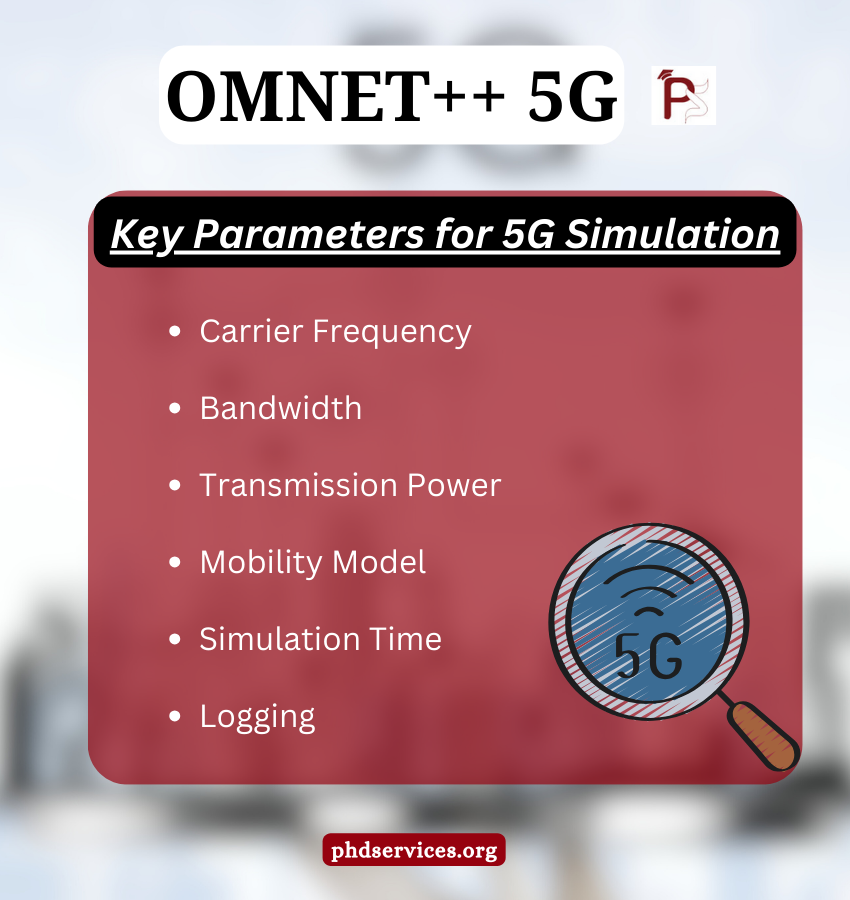

Several modules and parameters play a crucial role in simulating 5G networks. Some of the ideas and topics that we have guided scholars are mentioned below, we maintain all your work confidential so rest assured we will be the guiding lamp for your research path. For simulating 5G networks in OMNeT++, the following are the major modules and their parameter explanations:
Major Modules for OMNeT++ 5G Simulation
Installing and Configuring the Modules
git clone https://github.com/Unipisa/Simu5G.git
Arranging the Simulation Environment
Instance Simulation Scenario
The following is an instance of a basic 5G network simulation setting employing Sim5G and INET:
NED File: Simple5GNetwork.ned
package simple5gnetwork;
import inet.node.inet.Router;
import inet.node.inet.StandardHost;
import inet.mobility.static.StaticMobility;
import simu5g.node.basenode.gnb.Gnb;
import simu5g.node.ue.NrUe;
import simu5g.scenario.MobilityConfiguration;
network Simple5GNetwork
{
types:
channelChannelType extends ned.DatarateChannel
{
datarate = 1Gbps;
delay = 1us;
}
submodules:
gnb: Gnb {
@display(“p=100,100”);
}
ue[5]: NrUe {
@display(“p=200,100+$index*50”);
}
connections:
ue[0].gnbPhy <–> channelChannelType <–> gnb.gnbPhy;
ue[1].gnbPhy <–> channelChannelType <–> gnb.gnbPhy;
ue[2].gnbPhy <–> channelChannelType <–> gnb.gnbPhy;
ue[3].gnbPhy <–> channelChannelType <–> gnb.gnbPhy;
ue[4].gnbPhy <–> channelChannelType <–> gnb.gnbPhy;
}
INI File: omnetpp.ini
[General]
network = simple5gnetwork.Simple5GNetwork
# Simulation time
sim-time-limit = 10s
# Configure the gNB
*.gnb.gnbMac.maxTxPower = 40mW
*.gnb.gnbMac.carrierFrequency = 28GHz
*.gnb.gnbMac.bandwidth = 100MHz
*.gnb.mobility.typename = “StaticMobility”
*.gnb.mobility.initialX = 100m
*.gnb.mobility.initialY = 100m
# Configure the UEs
*.ue[*].ueMac.maxTxPower = 20mW
*.ue[*].ueMac.carrierFrequency = 28GHz
*.ue[*].ueMac.bandwidth = 100MHz
*.ue[*].mobility.typename = “StaticMobility”
*.ue[*].mobility.initialX = 200m
*.ue[*].mobility.initialY = 100m+$index*50m
# Enable logging for MAC and PHY layers
*.gnb.gnbMac.logging = true
*.ue[*].ueMac.logging = true
Executing the Simulation
Major Parameters for 5G Simulation
Examining the Results
How to simulate 5G network projects using OMNeT++?
The process of simulating 5G network projects with OMNeT++ is determined as challenging as well as fascinating. We offer an extensive instruction that assist you to begin with simulating 5G networks utilizing OMNeT++ and the Simu5G module:
Step 1: Install OMNeT++
Step 2: Install INET and Simu5G Modules
cd /path/to/omnetpp-5.x
git clone https://github.com/inet-framework/inet.git
git clone https://github.com/Unipisa/Simu5G.git
Step 3: Develop a New Simulation Project
Step 4: Define the Network Topology
package my5gproject;
import inet.node.inet.Router;
import inet.node.inet.StandardHost;
import inet.mobility.static.StaticMobility;
import simu5g.node.basenode.gnb.Gnb;
import simu5g.node.ue.NrUe;
import simu5g.scenario.MobilityConfiguration;
network Simple5GNetwork
{
types:
channel ChannelType extends ned.DatarateChannel
{
datarate = 1Gbps;
delay = 1us;
}
submodules:
gnb: Gnb {
@display(“p=100,100”);
}
ue[5]: NrUe {
@display(“p=200,100+$index*50”);
}
connections:
ue[0].gnbPhy <–> ChannelType <–> gnb.gnbPhy;
ue[1].gnbPhy <–> ChannelType <–> gnb.gnbPhy;
ue[2].gnbPhy <–> ChannelType <–> gnb.gnbPhy;
ue[3].gnbPhy <–> ChannelType <–> gnb.gnbPhy;
ue[4].gnbPhy <–> ChannelType <–> gnb.gnbPhy;
}
Step 5: Configure Simulation Parameters
[General]
network = my5gproject.Simple5GNetwork
# Simulation time
sim-time-limit = 10s
# Configure the gNB
*.gnb.gnbMac.maxTxPower = 40mW
*.gnb.gnbMac.carrierFrequency = 28GHz
*.gnb.gnbMac.bandwidth = 100MHz
*.gnb.mobility.typename = “StaticMobility”
*.gnb.mobility.initialX = 100m
*.gnb.mobility.initialY = 100m
# Configure the UEs
*.ue[*].ueMac.maxTxPower = 20mW
*.ue[*].ueMac.carrierFrequency = 28GHz
*.ue[*].ueMac.bandwidth = 100MHz
*.ue[*].mobility.typename = “StaticMobility”
*.ue[*].mobility.initialX = 200m
*.ue[*].mobility.initialY = 100m+$index*50m
# Enable logging for MAC and PHY layers
*.gnb.gnbMac.logging = true
*.ue[*].ueMac.logging = true
Step 6: Implement Applications and Traffic
*.ue[*].numApps = 1
*.ue[*].app[0].typename = “UdpBasicApp”
*.ue[*].app[0].destAddresses = “gnb”
*.ue[*].app[0].startTime = uniform(1s, 2s)
*.ue[*].app[0].stopTime = 10s
*.ue[*].app[0].messageLength = 1024B
*.ue[*].app[0].sendInterval = uniform(0.1s, 0.2s)
*.gnb.numApps = 1
*.gnb.app[0].typename = “UdpSink”
Step 7: Execute the Simulation
Step 8: Examine Results
Instance: Advanced Configuration
To encompass interference management, network slicing, mobility models, handover settings, and more, you can adapt the NED and INI files for more progressive simulations.
Advanced NED File Instance
package my5gproject;
import inet.node.inet.Router;
import inet.node.inet.StandardHost;
import inet.mobility.static.StaticMobility;
import simu5g.node.basenode.gnb.Gnb;
import simu5g.node.ue.NrUe;
import simu5g.scenario.MobilityConfiguration;
network Advanced5GNetwork
{
types:
channel ChannelType extends ned.DatarateChannel
{
datarate = 1Gbps;
delay = 1us;
}
submodules:
gnb: Gnb {
@display(“p=100,100”);
}
ue[5]: NrUe {
@display(“p=200,100+$index*50”);
}
core: StandardHost {
@display(“p=50,100”);
}
connections:
gnb.ethg++ <–> ChannelType <–> core.ethg++;
ue[0].gnbPhy <–> ChannelType <–> gnb.gnbPhy;
ue[1].gnbPhy <–> ChannelType <–> gnb.gnbPhy;
ue[2].gnbPhy <–> ChannelType <–> gnb.gnbPhy;
ue[3].gnbPhy <–> ChannelType <–> gnb.gnbPhy;
ue[4].gnbPhy <–> ChannelType <–> gnb.gnbPhy;
}
Advanced INI File Instance
[General]
network = my5gproject.Advanced5GNetwork
# Simulation time
sim-time-limit = 20s
# Configure the core network
*.core.numApps = 1
*.core.app[0].typename = “UdpSink”
*.core.ipv4.arp.typename = “Arp”
# Configure the gNB
*.gnb.gnbMac.maxTxPower = 40mW
*.gnb.gnbMac.carrierFrequency = 28GHz
*.gnb.gnbMac.bandwidth = 100MHz
*.gnb.mobility.typename = “StaticMobility”
*.gnb.mobility.initialX = 100m
*.gnb.mobility.initialY = 100m
# Configure the UEs
*.ue[*].ueMac.maxTxPower = 20mW
*.ue[*].ueMac.carrierFrequency = 28GHz
*.ue[*].ueMac.bandwidth = 100MHz
*.ue[*].mobility.typename = “LinearMobility”
*.ue[*].mobility.speed = 10mps
*.ue[*].mobility.startTime = uniform(0s, 1s)
*.ue[*].mobility.stopTime = 20s
*.ue[*].mobilit