


Audio signal processing projects is the process of performing computational operations on audio signals to improve the human interpretation of Audio. By the by, it enhances the audio quality by several processes such as noise reduction, frequencies (reduce or increase), add extra effects, analog-digital signal conversion, and many more. It supports audio improvisation and storing, analyzing, transferring, and recording the audio data. Moreover, the standard of audio signals may vary based on the requirement of the applications. For instance: microphones and mixing consoles are performed at lower level. We can see about the interesting research areas that are currently very popular among researchers. Here, we have handpicked only some of the significant areas for your information. More than this, we stretch our support in all other growing areas which has strong future scope of study.
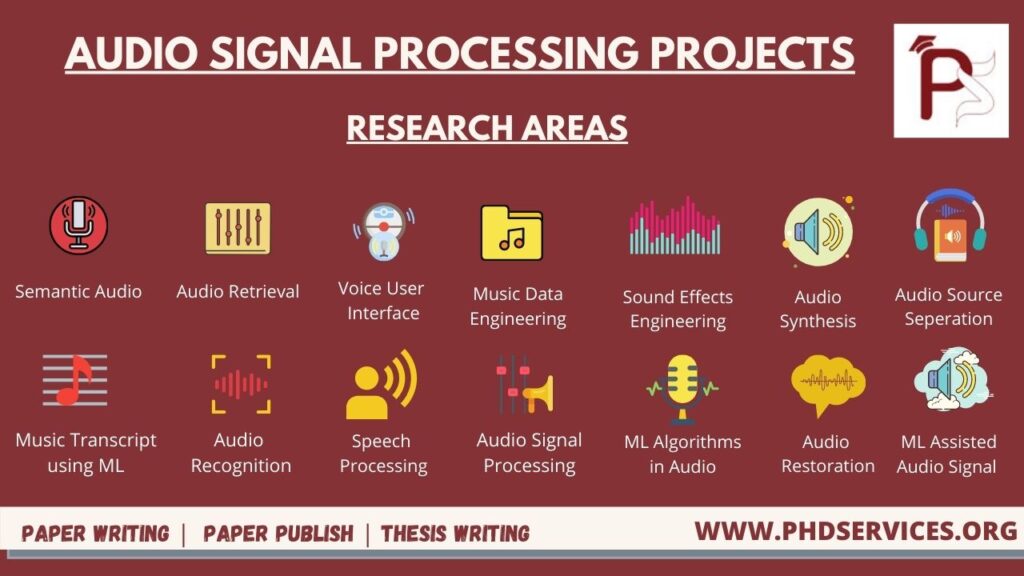
Audio Signal Processing Research Areas
- Semantic Audio (ontologies, description and production)
- Content-based Auto-Tagging and Audio Retrieval
- Music Data (informatics, retrieval and suggestion)
- Voice User interfaces for Audio Processing
- Intelligent Sound Effects and Engineering
- Audio Source Separation and Restoration
- ML assisted Automated Music Transcription System
- ML based Audio Signal Processing
- Different Learning Methods for Audio Processing
- Optimized GAN Applications for Audio Synthesis
- ML and Cognitive Models for Sound Recognition
- Mathematical Approaches for ML Algorithms in Audio
- Language, Speech and Audio processing
In addition, our research team is like to share few latest research topics / notions for your Audio Signal Processing Projects. These notions are sure to create the masterpiece in your research career.
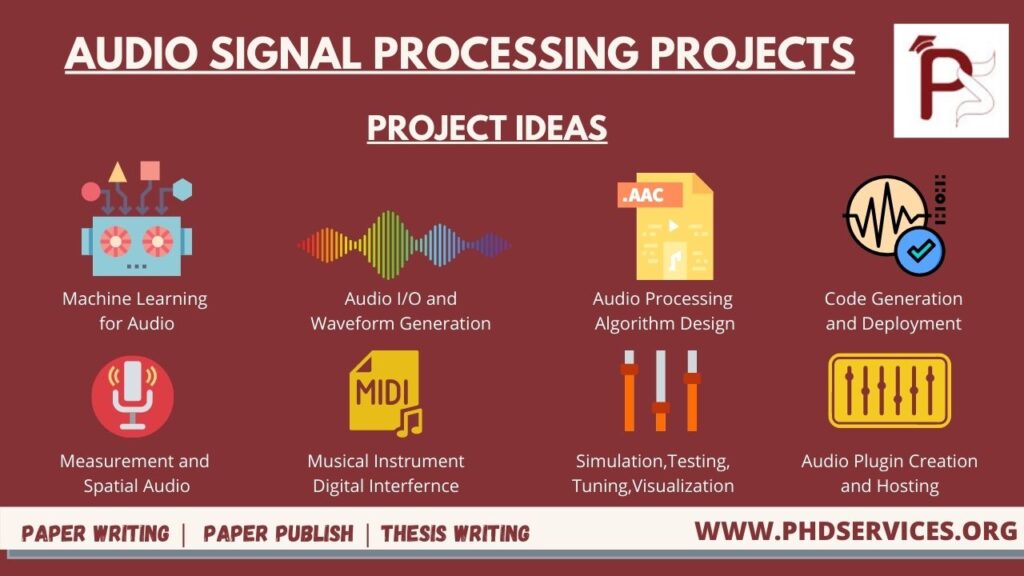
Audio Signal Processing Project Ideas
- Machine Learning and Deep Learning for Audio
- Speech Encode and Decode
- Augmentation of Audio Data
- Audio / Signal Segmentation
- Applications of Acoustic
- Audio Dataset / Archive Handling
- Audio Feature Extraction
- Labeling Voice Information
- Audio I/O and Waveform Generation
- Audi collection by record and play
- Waveform Generation
- Read / Write of wave files
- Audio Processing Algorithm Design
- Tools and Technologies for Audio Processing
- Modularize and Deign Audio Processing algorithm
- Processing of Audio Stream
- Code Generation and Deployment
- Generate and Develop independent applications
- Audio Plugin Creation and Hosting
- Audio Plugin Hosting
- Generation of AU and VST Plugins
- Plugins Validation and Testing
- Measurements and Spatial Audio
- Measurement of SPL
- Psychoacoustics Applications
- HRTF Data Acquisition
- Impulse Response Measurement
- Acoustics and Audio Signal Processing
- Musical Instrument Digital Interface (MIDI)
- MIDI Data (Creation and Transmission)
- Simulation, Tuning, and Visualization
- Musical Instrument Digital Interface for Audio Signaling
- Test Benches for Audio Signaling
- Real-time Audio Application Designing
Before we finish, next we can see about the extensively used datasets that is appropriate for audio signal processing projects.
Audio Signal Processing Datasets
- Speech Dataset in Hindi Language
- Dataset: 600 voice samples with training and test data (include all audio formats)
- Dataset Size: 600mb about 1 hr 40 mins
- Each sample: 5-10 sec in .wav format
- Purpose: Speaker identification and Speech (recognition, synthesis and analysis)
- A Manitoban Speech Dataset
- Dataset: utterances
- Purpose: In order to give repeatable set of test words which includes phonemes, and MRPA
- Each record – 1 word uttered in 1 continuous session
- SDU-Haier-ND: A Dataset for Noise Detection
- Dataset: internal AC operation sound (composed in product quality examination)
- Includes both normal and abnormal sound samples in real-environs
- iNoise Indian Noise Database
- Dataset: Different noises (outdoor and indoor)
- Audio formats: Microsoft’s (Wave, PCM, RIFF), mono (11025 Hz) and 8 bit sounds
- Noise in Indian surroundings is varied with other western countries
- Purpose: Speech processing and analyzing in realistic noisy environment
This article is talks about the creative research ideas for current Audio Signal Processing Projects with the Datasets information!!!
What is Audio Signaling Processing? Things You Must Know Before Starting Audio Signal Processing Projects!
What are the characteristics of audio signal?
As a matter of fact, the audio signals are described the voltage level, bandwidth, power level, and nominal level metrics. Here, the correlation of voltage and power is computed from the signal impedance where the signal paths are either balanced or single-ended.
What is the range of audio signal?
Mostly, the frequencies of audio ranges from 20 Hz to 20,000 Hz but the people prefer to hear at lower frequencies. The frequency will be double, when the relation of audio and music frequency move on octave.
How does audio signal processing work?
In general, the working process of audio signal is mainly relies on frequency adjustments, noise filtering, digital signal conversion and integrating additional audio effects. All these processes are combined together to form the high-quality speech.
- At first, create and label the audio data
- Next, augment the data for preprocessing
- Then, extract the set of features
- After that, extract the essential features
- Then, construct the predictive analytical models
- At last, deploy the model
Further, we have given you the multiple techniques that are used in the audio signal processing. All these techniques are differing with each other because of their own characteristics in signal processing. Hence, each one plays major role in attaining the audio quality.
- Beamforming
- Resampling and Filtering
- Automatic Gain Control
- Audio Effects
- Equalization
- Acoustic Echo Cancellation
- Digital to Analog Converter (DAC)
- Analog to Digital Converter (ADC)
- Data Decompression and Compression
In audio signal processing, selecting the filtering technique in one of the major task involved in it. Since, it is used to eliminate the undesired echo, distortion and noise in raw audio input file. So, it is the basic operation performed at first in all the processes. Once the filter, filters the unwanted data in the audio file, then it pass the data for next operations. Here, we have discussed about the list of filters that let only particular range of frequencies for operations.
- Bandpass Filter
- Once the signal resampling process is processed then the bandpass filter process takes place to eliminate the add-on noise.
- It reduces the frequencies that are either above or below in compare to cut-off Then, it passes the frequencies that are in specified range.
- High-pass filter
- If the threshold is higher, then it filters and passes the frequency
- If the cut-off range is lower, it reduce the frequency
- Low-pass filter
- It allows only frequencies that are below the cut-off range and deny the frequencies that are above the cut-off range
- Band-rejection/stop filter
- It is the inverse process of bandpass filter and also called as notch filter. Most probably, the frequencies do not change and reduces frequencies that are in range to very low.
Actually, our resource team is well-established with well-known technical professionals and experts to help you in both research and development aspects. Also, we have native writers team to support you in manuscript writing and publication. Here, our developers have recommended some important audio processing toolbox with its supporting operations.
Tools for Audio Signal Processing
Audio Toolbox (MATLAB)
Audio Toolbox is the one of the tools used for modeling and analyzing the acoustic, audio and speech processing system in matlab. In specific, it deals with the acoustic metering, audio / signal processing and speech synthesis. Most importantly, this tool is composed with many algorithms that are used for processing audio signals. And, some of them are time stretching, equalization, audio feature extraction (pitch and MFCC) and acoustic signal metrics assessment (sharpness and noise) carried in audio signal processing projects.

How to take a real-time audio input in Matlab?
- At first, we need to create input or output system objects that required for implementation.
- Then, we create an audio stream loop which practices the frame by frame operation on collected audio or music file.
- Next, add a scope to view the audio stream loop’s input and output.
- At last, apply the suitable algorithms for further process of audio stream loop through python language. Also, the python has following libraries that help to work with audio files.
Python modules
- wave
- madmom
- io.wavfile
- SoundFile
- sounddevice
- pyglet
- audiolab
- librosa
On the whole, we are pleased to notify you that we will provide you the fullest support in your research journey with a guarantee of Top-quality Audio Signal Processing Projects research outcome