

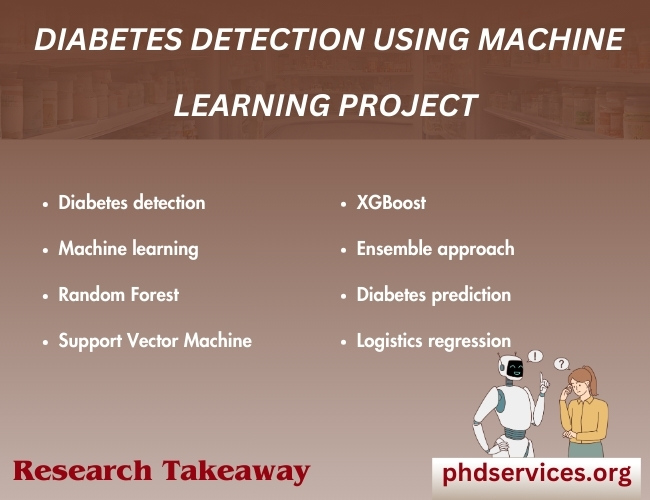
The detection of diabetes using machine learning which involves construct a model that predicts the chance of an individual suffering from diabetes depends on definite diagnostic measurements. Pima Indians Diabetes dataset is one of the famous datasets that we used in this process. We work constantly on Diabetes Detection Using Machine Learning Project so we well known about the hardships that scholars face while doing this project. Research Issues will be sort out and a complete solution will be given as we refer from leading and reputed journals.
Get a one-to-one solution for all your research hurdles, we work on all of machine learning projects so or experts will handle its difficulties very smartly. We have only PhD professionals in our concern for the better output of the work.
We listed here the fundamental steps to build such a project,
We utilize Pima Indians Diabetes Dataset that is available from the UCI machine learning repositories or through libraries like scikit-learn. The data is classified into training and testing datasets.
This evaluates the missing values and performs statistical analysis to learn the data distribution. It figures data to us by using histograms, scatter plots and many more to get the sense of connection between variables.
This sector decides the feature which is appropriate to prediction. If it required, the datasets are appear as a normalized or standardize manner. The fresh features are created depends on our domain knowledge or data exploration findings.
Initially, start with simple models like logistic regression. The difficult models are explored by us such as, random forests, gradient boosting machines and neural networks.
By using training set, we train the selected model. The performance of training set is observed with metrics includes, accuracy, F1-score, ROC, etc.
The model must test on a testing set. The performance of our model is explored with accurate metrics. If the models performance is not satisfied for us, then repeat the previous steps to enhance them.
Once we satisfied with the model, and then develop a web or mobile application for users to feed their data and get resulted predictions.
After the deployment process, collect real-world data and feedback from the users and domain experts. The new data is used for us to train and re-fine the model.
The simple program using scikit-learn with logistic regression is depicted here:
import pandas as pd
from sklearn.model_selection import train_test_split
from sklearn.preprocessing import StandardScaler
from sklearn.linear_model import LogisticRegression
from sklearn.metrics import accuracy_score
# Load data
url = “https://raw.githubusercontent.com/jbrownlee/Datasets/master/pima-indians-di
Conclusion
Finally, this article act as a guide for us to create a project based on diabetes prediction. Our project gets update regularly on the latest advancements.So,have in touch with us to follow the latest topics under Diabetes Detection Using Machine Learning Project.
Some of the best thesis works of our professionals are shared. Thesis ideas along with the solution will be clearly explained by us. All the queries will be solved immediately. Our service is intended to assist you persuasive research work and stand as a iconic piece in your academic carrer.
Keywords
Diabetes detection, KNN, Machine learning, Random Forest, Support Vector Machine, XGBoost
Forecasting of type 2 diabetes through the utilization of various ML approaches is the main objective of our study. We evaluated several methods such as Support Vector Machine, K-Nearest Neighbours, XGBoost, and Random Forest Regression. We compared these methods in terms of various metrics to find out the efficient one. Results show that, Random Forest achieved highest outcomes than others.
Keywords
Diabetes, SMOTE Oversampling, Ensemble approach, soft voting
From research proposals to thesis and dissertation writing, we provide professional academic support for every stage of your research journey including paper writing and publication assistance.
A main goal is to build a ML based framework to predict the diabetes in future. For obtaining efficient results, we performed various procedures such as data cleaning, preprocessing etc. We handled imbalanced dataset by using Smote technique. We selected relevant features by employing various feature selection methods. We employed ML methods like RF, KNN, NB, SVM, GB, DT and LR. Then we integrated all ML methods by utilizing voting classifier.
Keywords
Diabetes prediction, classifiers, logistics regression, naive bayes, kstar
In our research, to forecast the diabetes affected person, we utilized different ML methodologies like Naive Bayes, Logistic Regression, KStar, and Random Forest through the utilization of K fold cross-validation. A comparative analysis is performed in our study in terms of different metrics. As a consequence, Random Forest method provides greater efficiency. We conclude that, our suggested approach helps to diagnosis diabetes at its early stage.
Keywords
Artificial Intelligence, Disease Detection, Healthcare
For the early forecasting of diabetes, we employed several ML methods including Logistic Regression (LgR), k-Nearest Neighbors (k-NN), Support Vector Machine (SVM), Random Forests (RF), XGBoost, and LightGBM. To find out the optimal method, we evaluated the efficiency of all these methods. In that, LightGBM offers better end results. At last, we proved that, our recommended system is more efficient than other previous researches.
Keywords
Data mining, accuracy, F-1 score, robustness, Extra tree Classifier
A concept of data mining and ML techniques are employed in our study for diabetes prediction. We examined the efficiency and severity of utilized methods by considering correlating accuracy and F-1 rankings. Here we performed comparative study for these methods. At last, Extra Tree Classifier performs better than SVM. Our research aims to develop an innovative approach to assist the healthcare professionals for early diabetes diagnosis.
Keywords
Convolutional Neural Network (CNN), GLCM (Gray Level Co-occurrence Matrix), Diabetic Retinopathy (DR)
A main concentration of our work is to forecast the diabetic retinopathy through the utilization of different ML methods such as CNN, GLCM, and RF. We examined the effectiveness of the employed methods by considering several metrics. From the analysis, we conclude that, CNN method provides highest outcomes. We also build a website by using Django to categorize the diabetic retinopathy into various types.
Keywords
Algorithms, Classification, Gaussian Naive Bayes, Support Vector Classifier, Decision Tree Classifier, K-Nearest Neighbors
To predict the diabetes by employing several ML methods is an ultimate goal of our study. We detected the optimal method by evaluating various techniques including Support Vector Classifier, Gaussian Naive Bayes, Random Forest, Decision Tree Classifier, Logistic Regression, Extra Tree Classifier, K-Nearest Neighbors, and XGBoost. Results show that, Extra Tree Classifier achieved greater efficiency than other methods.
Keywords
Pre-processed data, SMOTE, Balance data, Features selection
We recommended an efficient ML framework in our research for anticipating diabetes disease. We employed many ML techniques such as LnR, LR, KNN, NB, RF, SVM, and DT. We preprocessed the data by eliminating null values and performing data standardization, normalization, and data labeling. We also overcome the problem of unbalanced data by utilizing SMOTE technique. From the analysis, we state that, RF method generates efficient end results.
Keywords
Bio-inspired, metaheuristic, chronic disease, type 2 diabetes, detection, cuttlefish
Enhancing the performance of previous techniques in the type 2 diabetes identification is the major objective of our article. After preprocessing the data, we selected relevant features by employing a bio-inspired metaheuristic method named cuttlefish. We compared the efficiency of our suggested method with other bio-inspired metaheuristic-based feature selection method denoted genetic method. As a consequence, cuttlefish method outperformed the other method.
Keywords
Several ML based techniques are examined in our study to forecast the diabetes diseases. We also carried out our approach with ML methods through the utilization of grid search cross-validation. We evaluated the performance of our recommended framework by using the specified PIMA diabetes dataset. Results show that, out of all utilized methods, Random Forest offers greater outcomes and the employment of grid search cross-validation also enhance the accuracy.

PhDservices.org is not owned by any single individual. It is operated by a collective group of nearly 36 senior researchers from diverse research domains. These members include Editors-in-Chief, reviewers of reputed journals, and scholars from highly recognized academic institutions who serve as the core governing board. The organization follows an annual leadership model, where a President is elected each year to head and represent the Academic Research Concern
PhDservices.org is Establish research organization dedicated to empowering scholars and helping them overcome research-related stress. With over 18 years of expertise across diverse research domains, our team delivers high-quality, original and impactful research solutions. Since 2007, we have successfully supported more than 50,000 PhD and MS scholars with reliable, innovative, and scholar-focused guidance. Our services are seamless, trusted, and strengthened by a vast academic and journal-based research community. Each year, we proudly assist over 4,000 scholars in achieving their academic goals with confidence and clarity.
United States | United Kingdom | Egypt | Saudi Arabia | Malaysia | Turkey | Canada | Australia | United Arab Emirates | China | Singapore | Tunisia | Jordan | Ireland | Qatar | Bahrain | Kuwait | Dubai | London | Oman
Bangalore | Delhi | Hyderabad | Chennai | Mumbai | Pune | Kerala | Kolkata | Chhattisgarh | Gujarat | Maharashtra | Punjab | Rajasthan | Telangana | Uttar Pradesh | West Bengal | Ahmedabad | Visakhapatnam | Trivandrum | Cochin
Computer Science | Information Technology | Electrical | Electronics & Communication | Mechanical | Civil | Chemical | Aerospace | Industrial | Metallurgical | Materials Science | Mechatronics | Automobile | Control Systems | Instrumentation | Biotechnology | Pharmaceutical | Genetics | Food Technology | Agricultural | Dairy Technology | Geological | Nanotechnology | Forensic Science | Psychology | Public Administration | Economics | International Relations | Education | Commerce | Business Administration | Physics | Chemistry | Mathematics | Computational Science | Statistics | Biology | Botany | Zoology | Microbiology | Genetics | Genomics | Immunology | Neurobiology | Bioinformatics
© 2025 PhD Services. All Rights Reserved.