

Keywords
Electricity Demand Forecast, Machine Learning, Prediction, Linear Regression (LR), Decision Tree (DT), Random Forest (RF), Support Vector Regression (SVR), K nearest Neighbors (KNN), XGBoost, Artificial Neural Network (ANN)
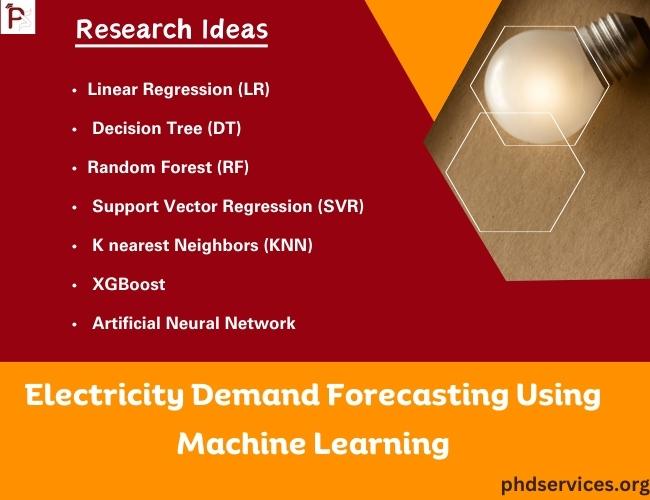
An electricity demand prediction framework is constructed in our article to forecast the electricity demand. We employed various ML approaches like Linear Regression, Decision Tree, Random Forest, Support Vector Regression, K-Nearest Neighbors, XGBoost, and Artificial Neural Network to analyze the efficiency of these methods. We compared these methods in terms of several metrics. As a result, Random Forest provides greater outcomes than others.
2.Integrating Weather Patterns into Machine Learning Models for Improved Electricity Demand Forecasting in Sri Lanka
Keywords
Electricity demand, weather patterns, forecasting
A prediction of monthly electricity demand in terms of historical data and weather patterns is the major goal of our research. We predicted the monthly electricity demand by utilizing Vector Auto Regression (VAR) and Long Short-Term Memory (LSTM) techniques. From the analysis, we described that, the VAR technique provides lower scores in evaluation metrics such as RMSE, MSE etc. Therefore, VAR technique is considered as an optimal method.
Keywords
Medium neural networks, whale optimization algorithm, support vector machine, error metrics, multi regression equations, Turkey
A combined model of MNN, WAO, and SVM is proposed in our paper to forecast the electricity demand. We carried out comparative analysis to evaluate the efficiency of these techniques by considering several statistical error metrics. We showed the connection among actual data and evaluated values and connections among dependent and independent attributes by using correlation matrix. As a consequence, MNN technique achieved better performance.
4.Electricity Demand Forecasting with Hybrid Statistical and Machine Learning Algorithms: Case Study of Ukraine
Keywords
National electricity demand, ARIMA, LSTM
An innovative integrated technique for prediction of national demand electricity is suggested in our study by utilizing statistics and ML methods. We utilized macroeconomic regression to examine long-term yearly trend. We illustrated error term by the integrated ARIMA and LSTM “black-box” related model. We analyzed hourly session by using calendar regressors and multiple ARIMA technique. In that, an integration of multiple regression framework and LSTM hybrid framework is considered as an efficient framework for residual forecasting.
5.A Comparative Analysis of Supervised Machine Learning Algorithms for Electricity Demand Forecasting
Keywords
Big data, random forest regression
A medium term electricity demand forecasting is carried out in our study by examined supervised machine learning approaches. We compared the performance of various methods including LR, MPR, SVR, ENR, GBR, DTR, RFR, and KNNR by considering different metrics. Results show that, non-parametric ML approaches provides greater efficiency when compared to parametric approaches.
6.Performance Comparison of Simple Regression, Random Forest and XGBoost Algorithms for Forecasting Electricity Demand
Keywords
Electricity Consumption, Regression Techniques, Supervised Learning
By utilizing supervised learning based method named Linear Regression and ML based methods such as Random Forest and XGBoost; we developed a system for electricity utilization prediction in our research. In an hourly basis, by considering meteorological attributes and public holidays, we predicted the short-term consumption load. We also evaluated the efficiency of utilized methods in prediction process.
Keywords
Household electricity demand forecasting, Residents’ psychological preferences, Calendar variables, Feature selection
In our study, a preprocessing of data with stationarity of time series is developed to handle the irregular trend factors. We selected important features by utilizing integrated method of RF and autocorrelation analysis. We employed various ML methods like KNN, SVR, RF and MLP to develop an integrated household electricity demand (HED) prediction framework. We aimed to add residents’ psychological preferences and calendar attributes and examined their impacts on HED.
Keywords
Deep neural network, Model assessment, Short-term load forecasting, Long Short-term Memory Networks, Demand response
The common approaches of short-term load prediction are described in our article. We illustrated the fundamentals of LSTMs and SVM methods. We also carried out procedures like preprocessing of data and feature selection. We employed LSTMs and SVM methods for one-hour ahead load prediction and one-day ahead peak and valley load prediction. When there is an adequate load data, LSTM method provides greater efficiency and in the case of inadequate load data, SVM method offers effective performance.
Keywords
User behavior analysis, ensemble learning
For efficient short-term load forecasting (STLF), our article examines about the smart sensor data that suggests user behavior may be applied to ML based methods. Here we considered several input factors like external attributes and sensor data in some perspectives. We utilized decision tree related ensemble learning technique to build various STLF systems for every input factor. From the analysis, the system trained with only external attributes achieved greater results.
10.Electricity demand forecasting in industrial and residential facilities using ensemble machine learning
Keywords
Energy, artificial intelligence
Ensemble ML techniques are employed in our research to construct an electricity demand prediction framework. We carried out various phases of preprocessing like handling of missing values, eliminating outliers, and standardization. To enhance accuracy and to minimize training time and overfitting issues, we extracted the features. We utilized grid search technique to optimize the appropriate framework. As a result, Extra Trees Regressor based day ahead framework is considered as an efficient framework in terms of various metrics.