


Face emotions are significant ways for humans to communicate with one another. In recent times, developing technology with the potential to automatically recognize facial emotions from photos and videos has become a hot topic of research. This article provides a complete picture of face emotion Recognition using Java.
Understanding such signs is difficult, and more exploration into how they connect to human empathy is required. RGB, multi-model facial expressions, and three-dimensional image analyses are important areas of study in face emotion recognition.
Let us first start with an introduction on face emotion recognition,
Introduction for face emotion recognition
- Human emotion recognition is used in a variety of situations when additional security checks or knowledge about individuals become essential.
- It could be viewed as a follow-up to facial detection, in which we may well be expected to execute a higher level of security that detects both the face and the emotions.
- This is useful in ensuring that the individual at the front of the camera is not merely a two-dimensional projection.
- As you know, Anxiety, Scorn, Hatred, Race, Astonishment, Sadness, Happiness, and Neutrality are all examples of human feelings. These are all very faint feelings.
- Human facial convolutions are quite little, and recognizing them can be difficult because even slight variations might result in diverse emotions.
- Also, because sentiments are very context-dependent, various or even the same people’s gestures for the very same feeling may alter.
Therefore doing face emotion recognition projects might require the support of experts in the field who can guide you throughout your research career. Here we present you with the most demanded project support for face emotion recognition provided to you by research experts in the field who have more than two decades of experience.
So you can get all sorts of support for your face emotion recognition project using python from us. Let us now talk about the uses of emotion recognition,
What is emotion recognition used for?
- Emotion recognition seems to be a software technique that allows a program to “analyze” the emotions on a facial expression using advanced image processing.
- Emotion recognition, biologically based brainwaves, necessitates the use of effective and stable signal processing and pattern extraction techniques.
- Current methods derive meaningful information from a given amount of electroencephalography (or EEG) channels using a range of approaches.
Hence emotion recognition plays a very significant role in many of the fields of day-to-day applications. As a result, advanced research is being taken up in this field to improve accuracy. Get in touch with our technical team who stay highly updated about face emotion recognition using java research. We will now talk about the working of face emotion recognition systems
How does face emotion recognition work?
In case of any given trials, the following are the extracted features using classifiers where emotion labels for the trials are obtained using majority voting classifiers at two distinct levels
- Calm
- Pleased
- Relaxed
- Distressed
- Happy
- Depressed
- Miserable
- Excited
Usually, all these emotions are detected and analyzed efficiently by any kind of face emotion recognition system. We have huge experience in delivering face emotion recognition projects on all these aspects. Quite importantly we provide that necessary technical knowledge is needed to research in this field. Let us now look into the face emotion recognition libraries associated with Java
Libraries for Face Emotion Recognition using Java
- OPENCV Library
- This library is commonly used for extracting facial features in OpenCV Projects
- ImageJ
- ImageJ seems to be a software-based on Java primarily generated for handling images
- It consists of many plugins
- By using APIs, you can carry out processes
- TwelveMonkeys ImageIO
- This library called TwelveMonkeys ImageIO is meant to be a supplement to the Java ImageIO API, providing additional aid for other forms.
- The code would seem similar to the built-in Java programming language in most cases, but this will work with more image files after the required prerequisites are added.
- PNG, JPEG, WEBMP, GIF, and WEBMP have been the only image formats supported by Java by the standard.
- If you try to work with only a digital image in various formats, our program will refuse to read this and generate a NullPointerException while attempting to use the BufferedImage variables.
- PSD, PNM, HDR, IFF, TIFF, PCX, SGI, PICT, WMF, TGA, ICO, CUR, ICNS, Thumbs.db, and SVG are among the new formats supported by TwelveMonkeys.
- WEKA library
- This library is used in implementing any kind of neural network algorithms in facial emotion recognition
- AWT
- This is an inbuilt library based on Java that enables the users to carry out activities like displaying images, window creation, describing listeners, button defining, etc
- It permits the users to make image editing applications
- Extra installations are not required since Java is already inbuilt
- JDeli
- This is a Java-based image processing library as it provides for the following
- A vast number of pre-programmed image processing techniques
- Avoid JVM heap-related failures
- The custom () function simplifies the definition of new systems.
- Reduce the file size
- lower the size of the output file
- Increase the read and write speed
- Many image standards, like Heic, are supported
- OpenIMAJ
- OpenIMAJ seems to be a collection of Java applications that cover a wide range of topics, including computer vision, video processing, deep learning, voice recognition, Hadoop integration, and much more.
- Under “Modules,” you’ll find all of the OpenIMAJ project’s components.
- Only the picture processing portion is required.
Hence Java provides a better platform for face emotion recognition project ideas where more innovation and creativity can be built into advanced projects. We help you in writing algorithms and implementing codes in Java and any other software platform that you wish to work in.
Our research support facility has been highly sought by researchers around the world for the most reliable and trusted services that we provide. Let us now talk about face emotion recognition based Java programming
Java Programming for Face Emotion Recognition
- Java is the best high-level language in many modern-day applications
- It enables multiple functions for handling facial emotion recognition
Java programming becomes easier with the help of our experts. You can see our help at any time as we function both day and night to support our customers. Enough Face Emotion Recognition using JAVA projects have been guided by our experts in recent times as a result of which we gained huge use experience. You can find better research guidance for face recognition from us. Let us now look into the face emotion recognition Java packages
Java Packages for Face Emotion Recognition
- import java.io.* and import javax.imageio.ImageIO
- package com.techvidvan.imageprocessing and import java.awt.image.BufferedImage
A proper explanation of these technical aspects will be provided to you once you get in touch with us. Most often the research scholars reach out to us for explanatory notes and implementation tips with regard to these Java packages. Hence you can get all kinds of support for your face emotion recognition using Java projects. What are the Java classes for face emotion recognition?
Java Classes for Face Emotion Recognition
The following are the Java classes needed for performing certain activities
- import java.awt.image.BufferedImage;
- Buffered image objects can be held using this command
- RAM storage of images is enabled by this object
- import java.io.File;
- It is used in reading and writing images of files that you wish to import
- It is the representation of directory path names and files
- import javax.imageio.ImageIO;
- The image read and write operations can be performed by importing ImageIO class
- Static reading and writing methods at present in this class
- import java.io.IOException;
- Errors can be handled using this command
The Java BufferedImage class seems to be a subtype of the Image class. It’s being used to alter and manage visual information. ColorModel of picture data is used to create a BufferedImage. The upper left corner position of all BufferedImage objects is (0, 0). The mathematical explanations provided by us will cover all these technicalities. Let us now see the Java functions for using face emotion recognition projects.
Java Functions for Face Emotion Recognition
- getType()
- The image type is returned
- getMinX() and getMinY()
- These functions respectively denote the minimum X and Y coordinates of the BufferedImage
- getHeight()
- BufferImage height value is returned
- getRGB(int x, int y)
- The RGB color model integer pixel is returned (TYPE_INT_ARGB)
- Colorspace of default sRGB is returned
- copyData (WritableRaster outRaster)
- The arbitrary rectangle portion of the BufferdImage is computed
- getData ()
- The image is returned as one larger tile
- getColorModel()
- Image ColorModel class of the object is returned
- getData(Rectangle rect)
- BufferedImage arbitrary region is computed and returned by this function
- getGraphics()
- Two-dimensional graphics is obtained while retaining the backward compatibility
- copyData(WritableRaster outRaster)
- You can copy the arbitrary BufferedImage rectangular region to the specific WritableRaster
For a clear explanation of these functions, you can check out our website. Additional support for handling these functions will be made available to you once you reach out to us. Talk to our expert regarding any doubts regarding face emotion recognition systems. Let us now see the ways of changing the face orientation with the help of Java
How to change the face orientations using Java?
- flip(mat mat1, tangle mat2, int flip_value)
- The flip value picks the initial kind by comparing mat1 and mat2 to info and produce tangled entities. The following are the possibilities of flip values
- 0 – flipping along the x-hub
- 1 – flipping along the y-hub
- – 1 – flipping along with the x and y hub
- getRaster()
- The method recovers a readable raster, which is then used to extract the raw data from the input image.
- put(int push, int section, byte[] information) and get(int push, int segment, byte[] information)
- This is used in perusing and composing the raw data into tangle questions
Our technical team is quite well versed in all these aspects and so we can provide you with complete support for your face emotion Recognition using Java projects. Also, our Java developers will assist you throughout your research career making it interesting and fruitful. What are the recent research ideas in face emotion recognition?
Latest Research Ideas in Face Emotion Recognition
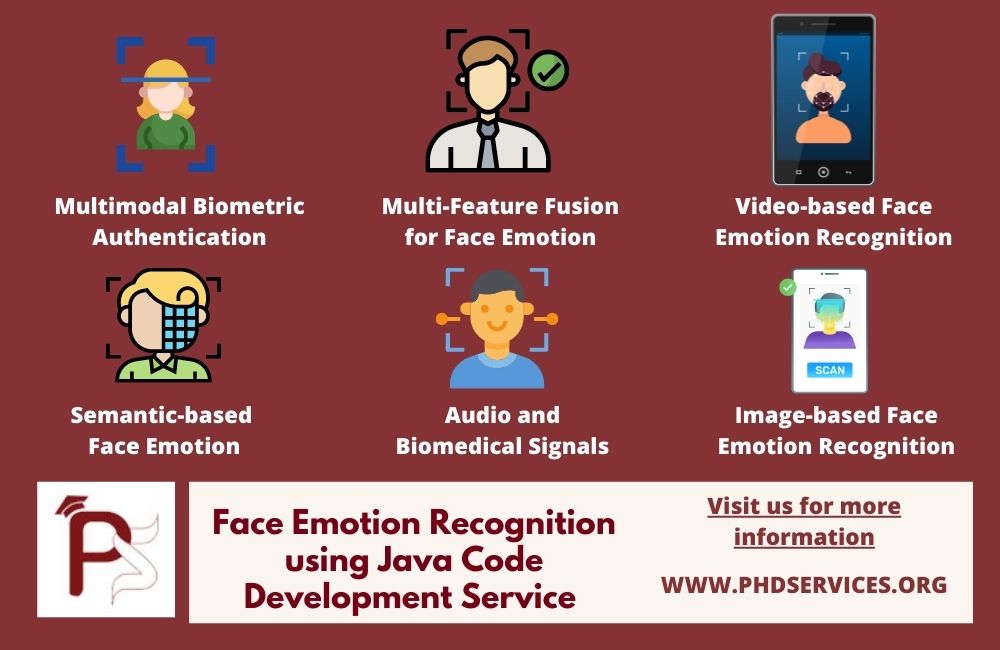
- Multimodal Biometric Authentication
- Multi-Feature Fusion for Face Emotion Recognition
- Video-based Face Emotion Recognition
- Semantic-based Face Emotion Recognition
- Audio and Biomedical Signals based Face Emotion Recognition
- Image-based Face Emotion Recognition
Given the rising requirement for computer languages, additional features based on cutting-edge methodologies like emotion detection are required to encourage and assist learning outcomes. All these research areas are very interesting and trending topics in face emotion Recognition using Java. Supportive techniques for educating computer languages currently mainly consider cognitive elements of the learner, disregarding various forms of behavior such as individual feelings. In all such aspects, you can get the ultimate support needed for your face emotion recognition projects from our experts. Get in touch with us for further details on our thesis writing services.