

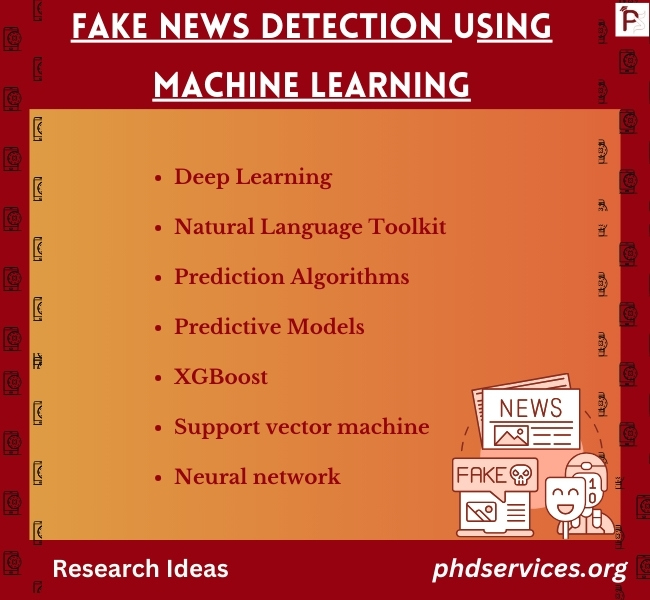
Machine learning based fake news detection comprises of categorization of news headlines or journals into genuine or fake by considering information. If you are looking for a research paper help within the limited budget rate we serve as a right choice for you, moreover we provide thought provoking ideas for your topics and carry over the entire writing part by our leading writers. Original and novel work will be shared. We demonstrate that, it is very critical approach because of the precise and very fine variations among true and fake news.
To develop a fake news detection framework, we discuss the procedural steps below:
Describe the major objective: To build a machine learning framework that categorize the news journals and articles into genuine or false.
Data Source: We identify false news by collecting our own information or utilizing the publicly available dataset.
To prevent the framework’s unfairness, make sure whether we obtain a balanced data or not ( for instance: same amount of false and true news journals)
Text Cleaning: In this process, we eliminate the URLs, numerical values, irrelevant white spaces and special characters.
Tokenization: Our project divides the text into separate tokens or words.
Stopword Elimination: We ignore the most utilized words that does not have specific meaning such as “the”, “is”, “and”.
Stemming or Lemmatization: Words are modified by us into their basic format like “running” is changed into “run”.
Text Vectorization: Various approaches including Count Vectorization, Term Frequency-Inverse Document Frequency (TF-IDF), and embeddings such as Word2Vec are utilized for the transformation of text data into number patterns.
We employ various methods such as Logistic regression, Gradient Boosting, Naive Bayes and DL based techniques including Transformers or LSTM for text categorization related tasks.
Divide the Data: Our approach splits the data into various forms like training data, test data and validation data.
Training: Frameworks are trained by us using training data and validate by utilizing validation data. Various metrics such as precision, F1-score, accuracy and recall are monitored.
By considering the above-mentioned metrics, we examine the efficiency of our framework using test data.
To interpret where our framework making errors, confusion matrix is considered by us.
We employ hyperparameter tuning by utilizing methods such as random search or grid search if initial findings does not meet our goal.
Consider factors like architecture, batch size, learning rate and other parameters when we are dealing with deep learning frameworks.
After the successful performance of our framework, we implement it on various environments like cloud or server. If we develop a web-based application, consider FastAPI, Flask and Django for backend processes.
We create an UI for users where they can feed news journals or headlines to make sure about the reliability of the information.
Our research documents the final results, gained skills and limitations.
Possible enhancements are recommended by us like elaborate the dataset with latest news, combining with actual world news data, or utilizing latest frameworks.
Tips:
Fake news identification is a complicated task and there is no proper framework. So, we examine the possible misguides and moral suggestions.
We often retrain the framework and dataset because of periodical emerging in the dynamic nature of false news.
To enhance identification accuracy, we make use of multimodal techniques that examine image, text data or metadata.
We conclude that, in this present digital world, due to the increase of fake information, a powerful fake news identification framework is very essential for single human or groups like companies.
By following the above framework, we complete the entire process, we assure you work will be completed within the limited set time. The tools and techniques that we used will be explained so that scholars understand the work. Save your valuable time by accessing our service.
Each professional wrier in our concern have a great knowledge and skills in machine learning department best help will be offered by us to complete the entire research paper with the world’s number one paper writing services.
Keywords
Fake news, healthcare, classification, deep learning, machine learning, readability features
From research proposals to thesis and dissertation writing, we provide professional academic support for every stage of your research journey including paper writing and publication assistance.
Two innovative models are recommended in our approach for fake news identification named Content Based Models (CBM) and Feature Based Models (FBM). We applied various ML methods such as DT, RF, SVM, AdaBoost-Decision Tree and AdaBoost-Random Forest and we compared these methods with integrated DL methods like CNN-LSTM and CNN-BiLSTM on each model. Results show that, AdaBoost-Random Forest in FBM offers greatest outcomes.
Keywords
Classification algorithms, fake news detection, feature selection, prediction algorithms, predictive models, XGBoost.
A fake news identification framework is suggested in our paper through the utilization of ML techniques. We obtained the relevant factors by evaluating the feature importance of each attribute by employing XGBoost technique. We employed and compared various methods such as SVM, RF, LR, CART, and NNET for fake news recognition. We also carried out the cross-validation step. From the analysis, we conclude that, RF method achieved better end results.
Keywords
Social media, support vector machine (SVM), neural network (NN), naive bayes (NB)
By employing ML techniques, we recommended a fake news recognition system in our study. Here we utilized various methods like Support Vector Machine, Naive Bayes, and Neural Network. Before applying ML methods, we performed normalization procedure to maintain the same dimension among all data. As a consequence, Support Vector Machine outperformed others.
Keywords
Natural Language Processing (NLP), Natural Language Toolkit (NLTK), Term Frequency-Inverse Document Frequency (tf-idf) Vectorizer, Ln-built and Custom ensembled Machine Learning (ML) Models, Support Vector Classifier (SVC), Logistic Regression (LR), K- Nearest Neighbors (KNN)
To categorize the news as legitimate or illegitimate, we developed a framework by using several ML approaches. For implementation, we utilized python as a scripting language. We employed ML methods like KNN and DT with an integrated approach comprised of RF and GB and custom ensembled methods like Stacking, and Maximum Voting Classifier for fake news identification. Stacking of methods like KNN, SVC, and LR into custom ensembles method generated highest efficiency in news categorization process.
Keywords
Classifier, Decision Tree, Random Forest, Gradient Boosting
A ML based framework is suggested in our article for false news recognition. We preprocessed the data by eliminating punctuation, tokenization, special characters, empty spaces, repeated words etc. and carried out stemming process and data discretization. We utilized several techniques such as LR, DT, RF and GB to detect false news from new articles. We conclude that, DT technique provides better outcomes when compared to others.
Keywords
Multilayer perceptron, ensemble learning
A main concentration of our study is to build an autonomous model for false news recognition by utilizing natural language processing of news texts. To forecast whether the news is false or not, we employed ML based categorization approaches. We evaluated and compared various techniques like LR, SVM, DT, KNN, multinomial NB, MLP and an ensemble model known as stacking. We state that, ensemble learner, SVM and MLP generates better efficiency.
Keywords
Blockchain, Rumour detection, InterPlanetary File system, Smart Contract
An innovative model utilizing ML method and blockchain is recommended in our research to identify the false news. We examined the authenticity of the information by evaluating the ratings given by normal people and experts about the information. To make the distributed framework, we utilized Ethereum blockchain. To stock the data, we employed InterPlanetary File System. We utilized blockchain to stock the hash of the metadata.
Keywords
Supervised Learning Models, Ensemble Model, Evaluation Metrics
A constructive recruitment fraud identification system is suggested in our paper by utilizing various ML techniques. To examine the job posting news like whether it is true or fake, we employed methods such as SVM, RF and NB. We utilized approaches like TF-IDF and BoW to extract the features. By training three separate methods, we developed an integrated approach. Finally, we conclude that, RF method provides effective end results.
Keywords
BERT, GloVe, LSTM, CNN
By utilizing multiple fact-checked news APIs, we created a dataset for fake news identification. We employed several ML approaches like NB, KNN, LR, SVM and DT to examine the created dataset. Then we utilized DL methods such as CNN and LSTM with GloVe and BERT embeddings. We performed experimental analysis for all these utilized techniques in terms of various metrics. From the analysis, we state that, LSTM with GloVe embeddings offers efficient results.
Keywords
In our fake news detection approach, we considered the covid-19 based information for classification process. We extracted markers from unstructured text information. Then we selected only the relevant features to minimize the system complexity. We employed different ML methods like SVM, NB, and DT. We carried out the comparative analysis in terms of various metrics. Results show that, DT method achieved greater outcomes.

PhDservices.org is not owned by any single individual. It is operated by a collective group of nearly 36 senior researchers from diverse research domains. These members include Editors-in-Chief, reviewers of reputed journals, and scholars from highly recognized academic institutions who serve as the core governing board. The organization follows an annual leadership model, where a President is elected each year to head and represent the Academic Research Concern
PhDservices.org is Establish research organization dedicated to empowering scholars and helping them overcome research-related stress. With over 18 years of expertise across diverse research domains, our team delivers high-quality, original and impactful research solutions. Since 2007, we have successfully supported more than 50,000 PhD and MS scholars with reliable, innovative, and scholar-focused guidance. Our services are seamless, trusted, and strengthened by a vast academic and journal-based research community. Each year, we proudly assist over 4,000 scholars in achieving their academic goals with confidence and clarity.
United States | United Kingdom | Egypt | Saudi Arabia | Malaysia | Turkey | Canada | Australia | United Arab Emirates | China | Singapore | Tunisia | Jordan | Ireland | Qatar | Bahrain | Kuwait | Dubai | London | Oman
Bangalore | Delhi | Hyderabad | Chennai | Mumbai | Pune | Kerala | Kolkata | Chhattisgarh | Gujarat | Maharashtra | Punjab | Rajasthan | Telangana | Uttar Pradesh | West Bengal | Ahmedabad | Visakhapatnam | Trivandrum | Cochin
Computer Science | Information Technology | Electrical | Electronics & Communication | Mechanical | Civil | Chemical | Aerospace | Industrial | Metallurgical | Materials Science | Mechatronics | Automobile | Control Systems | Instrumentation | Biotechnology | Pharmaceutical | Genetics | Food Technology | Agricultural | Dairy Technology | Geological | Nanotechnology | Forensic Science | Psychology | Public Administration | Economics | International Relations | Education | Commerce | Business Administration | Physics | Chemistry | Mathematics | Computational Science | Statistics | Biology | Botany | Zoology | Microbiology | Genetics | Genomics | Immunology | Neurobiology | Bioinformatics
© 2025 PhD Services. All Rights Reserved.