The process of creating a master thesis is determined as challenging as well as fascinating. Explore a variety of topics in your master thesis on remote sensing as we delve into diverse areas and embrace emerging fields. Receive a Turnitin Report and an AI free report when you choose phdservices.org for your article writing and publication needs. We offer a formatted technique that assist you to create your master thesis in the domain of remote sensing in effective manner:
Step 1: Selecting a Topic
A topic has to be selected in such a way that must fascinate you as well as coordinates with recent study patterns and social requirements. It is advisable to determine the regions where remote sensing has the ability to offer new approaches or perceptions. Typically, topics could encompass:
- The utilization of satellite data to track deforestation or urban extension.
- Examining crop health and forecasting farming yields employing UAV (Unmanned Aerial Vehicle) imagery.
- Mapping and tracking water quality in lakes and coastal regions utilizing multispectral satellite imagery.
- Researching the influence of climate variation on polar ice caps or glacier retreat by time-series satellite data.
Step 2: Literature Review
To interpret the recent range of study in your selected topic, methodologies employed, and any gaps that your research could overcome, aim to carry out an extensive analysis of previous literature. Generally, discussion events, thesis warehouses, and educational journals are considered as effective information sources.
Step 3: Data Collection
It is approachable to find and obtain the remote sensing data that are required for your study. The process of employing drone-captured imagery or downloading satellite images from environments such as ESA Copernicus Open Access Hub, USGS EarthExplorer, are encompassed. The spatial and temporal determination needed for your research has to be examined.
Step 4: Methodology
A methodology has to be created in such a way that summarizes in what way you will process, examine, and understand the remote sensing data. Typically, this might include:
- Pre-processing procedures such as geometric correction, image improvement, and atmospheric correction are encompassed.
- It involves analysis approaches like classification such as supervised or unsupervised, change identification, or vegetation index calculation.
- To explain the outcomes, include statistical analysis or modelling.
Step 5: Software and Tools
You must know about the software and tools that are required for your study. Usually employed software in remote sensing the encompasses:
- GIS Software: For spatial exploration and mapping, software such as QGIS, ArcGIS are utilized.
- Remote Sensing Software: ERDAS IMAGINE, ENVI are used for image processing.
- Programming Languages: Specifically, for data exploration, automation, and implementing machine learning methods, focus on employing R or Python.
Step 6: Writing Your Thesis
By dividing into explicit sections, design your thesis. Typically, it includes Introduction, Literature Review, Methodology, Results, Discussion, Conclusion, and References. It is approachable to assure that every section is arranged in a logical manner and your outcomes and discussion are clearly justified by your data and exploration.
Step 7: Results and Discussion
Your outcomes have to be demonstrated in an explicit, coherent way. To explain your findings, focus on employing charts, maps, and images. In the setting of previous studies, describe the impacts of your outcomes and their significance to actual-world problems.
Step 8: Conclusion and Future Work
It is appreciable to outline your major outcomes and their relevance. In addition, recommend in what way the research could be extended or enhanced, or valuable regions for upcoming investigations.
Step 9: Revision and Submission
For any mistakes or regions of enhancement, aim to analyse your thesis. The way of obtaining review or suggestions from mentors or experts can be very useful. After your thesis is finalized, it is advisable to adhere to the instructions for thesis submission that are offered by your university.
Is there any research topic for a masters in cartography and geovisualization?
In the domain of cartography and geovisualization, several research topics are there. The following are numerous research topics that has the capability to provide significant possibilities for dedication and advancement:
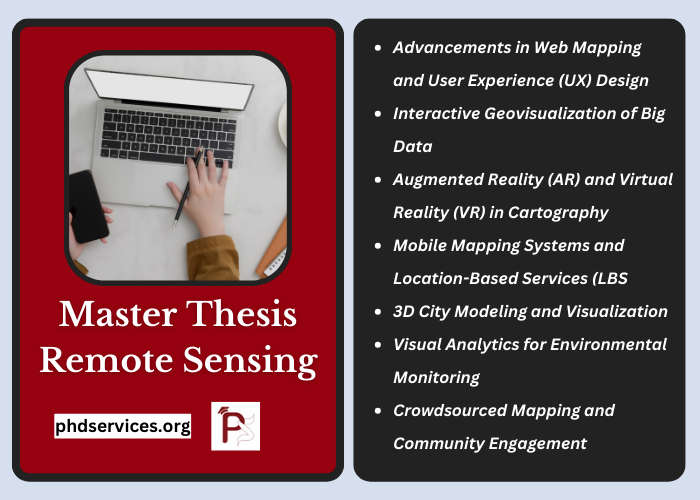
- Advancements in Web Mapping and User Experience (UX) Design
- Aim: In what way UX design standards can enhance the performance and user involvement of web mapping services has to be researched. For modelling more excellent and available web maps, examine novel systems or methodologies.
- Importance: Geospatial data are more available to wider viewers by improving the utility and availability of web-related GIS and mapping applications.
- Interactive Geovisualization of Big Data
- Aim: Integrating interaction and actual-time data processing, construct algorithms for the efficient geovisualization of huge data sets. Generally, the process of investigating new visualization approaches for spatial-temporal data from IoT devices, satellite imagery, or social media are involved.
- Importance: For assisting decision-making in ecological management, public wellbeing, and urban scheduling, this study helps in the interpretation and exploration of huge geospatial datasets.
- Augmented Reality (AR) and Virtual Reality (VR) in Cartography
- Aim: For improving map communications and spatial interpreting, study the application of AR and VR mechanisms. The advancement of AR apps is involved in this project for tourism, urban scheduling, or academics.
- Importance: For training, entertainment, and academics, in-depth expertises are offered by revealing novel angles for map communication and spatial visualization.
- Mobile Mapping Systems and Location-Based Services (LBS)
- Aim: Concentrating on user-centric models, confidentiality problems, or the incorporation of social networking characteristics, aim to investigate the progression of advanced LBS for mobile devices.
- Importance: This study dedicates to regions like marketing, social networking, and navigation, by improving the efficiency and user expertise of mobile mapping applications.
- 3D City Modeling and Visualization
- Aim: For developing extensive and precise 3D systems of urban platforms through integrating data from GIS, remote sensing, and other resources, aim to deal with methodologies. The utilization of these systems in calamity management, heritage preservation, and urban scheduling has to be examined.
- Importance: For offering extensive visualization for setting exploration, public involvement, and heritage conservation, this research offers beneficial tools for urban scheduling and management.
- Visual Analytics for Environmental Monitoring
- Aim: Mainly, to monitor variations in environments, climate change signals, or pollutant levels, it is appreciable to construct visual analytics tools that incorporate GIS data with ecological tracking data.
- Importance: Through offering robust tools for data testing and visualization, assists ecological management and decision-making.
- Cartographic Representation in Autonomous Vehicle Navigation Systems
- Aim: Concentrating on the precision, transparency, and actual-time data incorporation, research in what way cartographic standards can enhance the visualization interfaces of autonomous vehicles (AV) navigation models.
- Importance: By means of enhancing the visual communication of navigation information and ecological data, this topic improves the protection and performance of AV models.
- Crowdsourced Mapping and Community Engagement
- Aim: The influence on crowdsourced geographic data on urban scheduling, calamity response, and committee involvement has to be investigated. To enhance user inspiration, data quality, and the incorporation of crowdsourced data with official geospatial data resources, it is beneficial to examine efficient methods.
- Importance: Typically, this study enables committees and has the capability to improve participating scheduling procedures by utilizing the general expertise and analysis of inhabitants.