


Molecular communication refers to an upcoming field of study related to communication among nodes with the help of chemical-based molecules. Interdisciplinary molecular communication takes up concepts of various subjects like information technology, underwater communication, and the molecular communication in iot internet of nano applications.
“Through this article, we have provided a complete picture on molecular communication in IoT where we have first started by explaining the differences between conventional and Molecular communication types and ends with the dataset for molecular communication”.
A cooperative real-time system can be developed by establishing reliable communication among various nodes. Based on the field of application, circumstances, and signals being used the transverse and molecular communications vary.
Difference between molecular vs. traditional communication
- In traditional communication, the communication carrier is the electromagnetic waves whereas it is molecules in molecular communication
- Electronic, optical and electromagnetic signals are used in traditional communication while the chemical substances are the signals in molecular communication
- Traditional communication is established that the speed of light has speed is very low in case of molecular communication
- Almost immune wired communication and impact in wireless communication are the medium conditions for traditional communication and the medium of communication also impact molecular communication systems
- Electromagnetic signals and fields lead to noise aspects in traditional communication while the same is rendered by molecules and particles in molecular communication
- You can encode video audio and text in conventional communication whereas the chemical state, processes involved and phenomena are the encoded data in molecular communication
- High energy is consumed in case of traditional communication whereas the energy consumption is very low in molecular communication
These kinds of descriptive explanations on molecular communication in IoT can be found on our website. Our research experts and developers are highly qualified and skilled to support in-depth research in IoT-based molecular communications. Let us now talk about the working of Molecular communication
How does molecular communication works?
- The data carriers are the molecules in case of molecular communication
- In the side of the sender, data is encoded from biological nanomachines onto the molecules
- The data loaded molecules are then released into the environment
- Due to propagation, these molecules in the environment reach the biological nanomachines at the receiver end
- Then the biochemical reactions at the receiver biological nanomachines decodes the information
How is molecular communication established? You can get a better picture of its working by having a look into the following points which explains molecular communication in real-time with an example
- Particles are generated by the transmitters or they are stored within them which are in turn used to encode the information
- The size of these particles vary from the nanoscale to micrometers
- Examples of these particles include biological compounds like DNA, proteins, etc. and synthetic molecules like gold nanoparticles
- Various modulation techniques are used to encode the information onto the selected particles
- Data encoding is a function of the concentration and intensity of the particles. For instance, releasing three particles can denote bit 0 while releasing one particle corresponds to bit 1
- And also the data transmission depends on the type of particle being released or is used to communicate
If you are searching for the best and reliable online research guidance in molecular communication, then you can confidently get in touch with us. We have been providing research support to research scholars from all the top world universities around the world for more than twenty years. So we gained huge knowledge in all recent technologies related to molecular communication
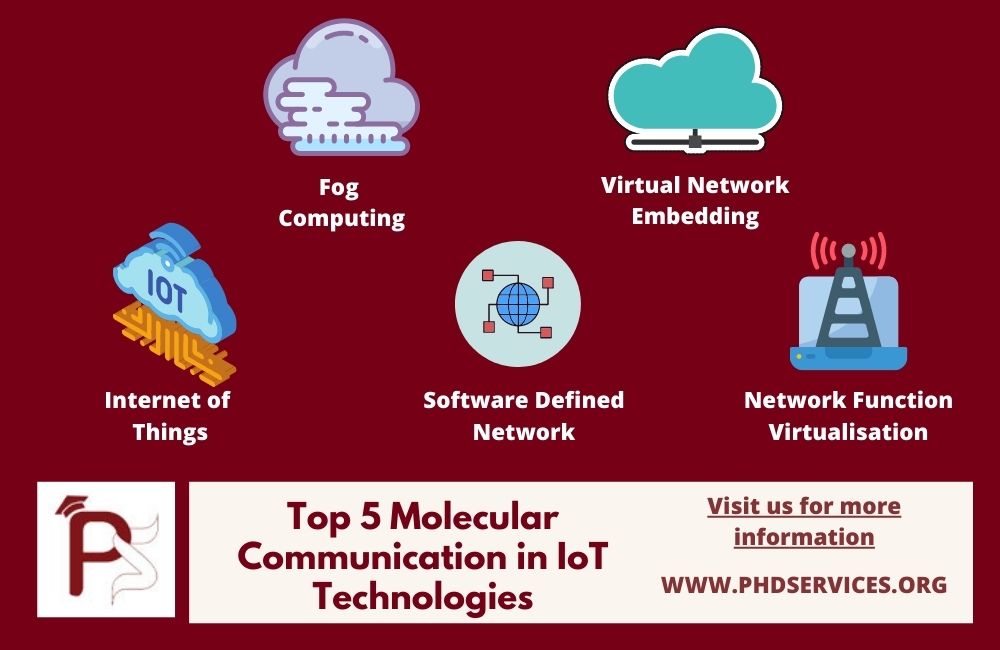
Top 5 Technologies of Molecular Communication
- Fog computing
- VNE or Virtual Network Embedding
- Internet of Things
- Software Defined Network
- Network Function Virtualisation
Since we gained a piece of vast knowledge in all these technologies of molecular communication, we have the potential to solve the issue associated with every layer of IoT architecture. The tedious task of providing research support is being aided by our experts more efficiently. Let us now look into the integration of molecular communication and the internet of things.
How does IoT integrate with molecular communication?
- On the Internet of Bio – NanoThings or IoBNT, biological cells are considered as Nano things for creating communication in nanotechnology. These tools are commonly called as Bio-Nano things
- The following are the capabilities of bio-nano things which are in line with the artificial nano things
- Control and coordination – Cell Nucleus
- Communication pathway – Signals
- Actuation and sensing units – Cilia, Pili, And Flagella
- Power production – Mitochondrion
Molecular communication is especially utilized in establishing communication among the body cells because the natural data exchange happens on this basis between two cells. The signal pathways or the chemical reaction chains are the basis on which molecular communication is established.
Data processing characteristics modulation (especially characteristics like molecular concentration) are the foundation on which modifier communication works. The following is the working of molecular communication system,
- The data is first encoded and then transmitted in the transmitter nanomachine which can be observed by digital modulation
- Propagation of encoded information takes place in molecular channels
- Reception of transferred data and decoding takes place in the receiver nanomachine which is, in turn, analyzed using digital demodulation
You will be provided with proper workflow diagrams and simple practical explanations by our engineers on different mechanisms and principles involved in molecular communication networks. The following are the two important scenarios of the internet of things where molecular communication gains significance
- Scenario – 1: Communication between Nanodevices and microsystems
- Scenario – 2: Nanodevice communication
You can get immediate explanations for all your queries related to molecular communication once you reach out to us. You can feel free to consult with our experts at any time. By giving a proper explanation of industrial and other day-to-day applications of molecular communication we will improve your perspective about the field. We will now discuss molecular communication applications
Applications of molecular communication in IoT
- Industrial applications
- Developing new materials
- Applications for controlling the quality of water and food
- Developing advanced materials and fabrics
- Biomedical research applications
- Mechanism for monitoring health
- Drug delivery systems
- Support for immune systems
- Environmental studies
- Assistance in biodegradation
- Control mechanisms for biodiversity and animals
- Controlling air pollution
- Telecommunication applications
- Advanced Information and Communication technologies and future internet
- Dynamic and smart system management
- Distributed execution in the environment with high unpredictability
- Military applications
- Defence mechanism consisting of nuclear, biological, and chemical systems
- Equipment’s for nano functions
If you want to get the major points related to operating systems, tools, and software associated with these applications then you can check out our website. Our engineers are well versed in working with all these OS. Let us now talk about molecular IoT architecture especially for biomedical applications.
The architecture of Molecular Communication in IoT Nano networks for biomedical
- The blood is collected from the patient’s body
- Electromagnetic Nano communication is established by monitoring pathogens, allergens, and chemicals in the collected sample
- Molecular nanonetworks are established using micro gateway
- The phone surface sensors are involved in query routing at the surface layer and context management layer
In all these aspects, molecular communication has revolutionized the field of biomedical engineering. You can get a great deal of support and guidance for your molecular communication IoT projects from us. In the following letters have a look into molecular communication IoT architecture,
The architecture of Molecular Communication
In the following, SDN-based IoT architecture is given for the molecular communication in which SDN is a control entity that processes the functioning of infrastructure i.e. internet of nano things.
- Infrastructure
- The conventional networks are now converted into multiple nanomachines as a result of molecular communication architecture using the internet of things
- Control plane
- It is represented by SDN controller
- Data plane
- OpenFlow switches with nano and micro gateways are used in representing forwarding and data plane
- Communication
- SDN controller is used in establishing secure communication within micro and Nano gateway
- OpenFlow is also associated with this SDN controller in the gateway (micro and nano)
- The communication in this gateway to nanomachines is particularly established by various methods for triggering and sending bitstreams
- Synchronisation
- Maintaining orchestration and synchronization among NFV and SDN controllers is essential for the implementation of various use cases and functions of nanonetworks
We are here to provide you with a complete explanation of all the technical terms and methodologies stated here. With the updated technical team of experts, we offer ultimate research guidance. Let us now look into the molecular communication recent trends.
Latest Trends in Molecular Communication
- Molecular communication and network interoperability especially among the networks of Internet of Things, IoBNT, BAN, and intra body communication
- Energy-efficient molecular communication network modeling with effective sources of power
- Cross-Layer Design of Application Layers, Link Layers, Network, MAC, and Physical layers
- Electromagnetic Nano communication based hybrid communication methods with integration to molecular communication
- Molecular communication network safety and various methods of implementation by utilizing nanoscience and nanotechnology
Therefore without a doubt, nanotechnology and the internet of things have enhanced the way in which molecular communication is established. For the structures and approaches involved in molecular communication, you can check out our website. We shall now see about the emerging topics of research in molecular communication.
Emerging topics in molecular communication
- Molecular communication networks’ energy harvesting and techniques for power transmission
- Molecular communication ligand-receptor interactions optimization and appropriate components along with the mechanism for transmission and reception
- Modelling of channels, receivers, and transmission devices and Molecular communication transceiver architecture based on synthetic biology
- Constraints associated with coexistence and biocompatibility and large scale experimental analytics
- Optimal design of architecture and protocols involved in the estimation of channel parameters, mitigating intersymbol interference, detection, and modulation design
- Molecular Network and traditional macroscale network by proper interfaces and MC channel model, transceiver and methods validation
- MC nanomaterials, biosensors, and microfluidics-based applications and its testbed implementation and design
- Practical implementation and working with molecular communication methodologies having fewer complexities especially in the case of Channel Estimation, Coding, Modulation, Detection, and Synchronisation
- Efficient physical design, system modeling and execution of various components of molecular communication like transmitters, channels, and receivers.
Since nano – communication is established among nanoparticles and devices. It has to meet the requirements of the NanoWorld. You need to use proper platforms and tools for simulation and take up advanced modeling techniques for introducing IoT and nano communication-based characterization. For this purpose, you can have a good interaction with our experts and get their viewpoints and experience. In the following section, let us discuss the simulation platforms associated with molecular communication,
Simulation models for molecular communication
The following are the five significant models implemented by simulation
- Channel loss model
- Receiver response model
- Model based on amplitude addressing
- Error analysis and transfer rate models
- OOK modeling
At present, we are offering molecular communication in IoT project reports using all these simulation software. We have got world-class certified teams of developers and writers who are ready to share a massive source of reliable research data to update you on the day-to-day advancements in your field. We will now look into the best simulators for Molecular communication projects
Simulators for molecular communication
- NanoNS
- Physical layer is a Diffusive channel while the Channel model is Glimpse modeling (for the process of stochastic reactions)
- Molecular mode emitting molecules is the protocol used and model-based numerical analysis is used for validation
- It is compatible with the NS2 network simulator and the programming language used is TCL and C ++
- Physical layer integration of NS2 protocol at the higher layers is the basic network architecture
- Nano – Sim
- Physical layer is the associated spectrum channel model
- Transparent and smartMAC, random and selective routing and spread OOK are the protocols implemented
- It is compatible with NS3 network simulator and C++ programming platform
- The network architecture is particularly based on NS3 higher layer protocols
- N3Sim
- Simulating collision and Baraff’s algorithms are the physical layers and channel models
- Molecules pulse trains generation protocols for various emitter types are implemented
- Java is the programming language used for this simulator
- Higher level layer protocols cannot be implemented in this architecture
- nanoNS3
- Physical layer and channel models are respectively bacterial receiver model and channel loss model
- Error analysis and transfer rate analysis model, OOK, NS-3 application layer, and source addressing protocols are implemented
- Experimental evaluation is conducted for validating purposes
- NS3 simulator is the most Compatible Network simulator and it is implemented on C++ programming language
- Higher layer NS3 protocols can be implemented in this network architecture
You can get support regarding executing the algorithm, obtaining source code, utilizing proper parameters, project configuration, and analysis guidance from us. We take complete care of every aspect of your research. Let us now talk about molecular communication datasets,
Dataset for molecular communication
Simulation and the creation of testbeds are important aspects of molecular communication. The following is a detailed note on one of the datasets proposed by our experts
- Proton pumping bacteria-based molecular communication testbed
- Experimentally authentic data are provided by this latest biological molecular communication testbed or MC Testbed
- Protons which are used as the signaling molecules are sent by this bacteria to the channel when an external stimulus is applied
- The pH sensor which acts as the receiver then senses the protons with environmental pH variation
- MC community-based communication schemes are experimentally evaluated by using this dataset
There are also many other datasets that you can use in your molecular communication projects from us. With the help of our qualified writers, you can get all details regarding specific chapters of the thesis and paper. We have now arrived at the conclusion
Conclusion
The advancements in the field of nanoscience have led to huge impacts in all fields. In such a way, it has also paved the way for the whole new paradigm of Molecular Communication in IoT Internet of Things wherein the data is encoded on molecules. Establish improper methods for using and controlling this technology has got potential to strengthen Healthcare, increase sustainable growth, and impact economics
Nanoscale devices, smart materials, actuators, and sensors are to be utilized to overcome the existing challenges in the field. As a big picture, we can finally conclude that effective networking mechanisms based on nanomachines can be established using molecular communication. Reach out to us to make your research work easier.