


Pattern Analysis is the main method to relate the hidden data with already stored information in the database. It is widely used in any field of computer science to match the common patterns/attributes of input data to the corresponding classes/clusters. Also, it is considered a learning process that is a part of pattern analysis in machine learning. This process is mainly used in the case of large-scale data. Since it is used to group similar data and classify them according to the pre-defined classes/categories.
This article describes your up-to-date research ideas ad challenges of pattern analysis machine learning!!!
Due to the vast advantages of pattern analysis, it is widely spread in several areas such as web searching, face recognition, information retrieval, handwriting identification, etc. Further, it also demands advanced pattern analysis techniques.
In recent days, the cooperative approach of machine learning over pattern analysis is effective in yielding accurate results. So, it largely gets attention from both scholars and business people who are working on data-intensive applications. Further, here we have given you a list of pattern recognition techniques that are commonly followed in much pattern analysis in machine learning projects.
List of Pattern Recognition Methods
- Ensemble Methods
- Clustering Methods
- Naïve Bayesian Models
- Stochastic Techniques
- Classification Methods
- Deep Neural Networks
- Effective Model Selection
- Evolutionary Computation
- Algebraic Linear Models
- Improved Learning Approaches
- Dimension Reduction Techniques
- New Machine Learning Algorithms
- Advanced Model / Shape Representation
Overview of Pattern Analysis in Machine Learning
Now, we can see the role of machine learning in finding and analyzing patterns in data. And also, how ML techniques are effective to solve pattern-related problems. As mentioned earlier, one of the major pattern analysis techniques is Machine Learning (ML). In general machine learning techniques usually convert the input data into numbers. Then, the patterns are recognized based on those numbers. To make this pattern analysis a simple task, it includes several algorithms. By the by, the algorithm is nothing but a set of rules to implement and execute the specific task(s).
So, it is obvious that the word “algorithm” in machine learning directly represents procedure. This procedure executes over information to create a machine learning “model”. In the case of pattern analysis in machine learning scenario, this model is intended to detect the patterns in data based on certain conditions.
In simple words, pattern recognition is defined as a colossal collection of numerical-statistical tools to detect similar and dissimilar patterns for specific applications. For instance: speech recognition, medical disease diagnosis, pixel-based image classification, voice recognition, character recognition, etc.
Even though this field is made up of so many advantages, it also comprises technical challenges while deploying in real-world applications. One of the main issues is handling large data to acquire targeted patterns. Further, it also includes the following fundamental issues in pattern recognition and analysis.
Traditional Issues of Pattern Analysis
- Patterns scaling
- Complex patterns recognition
- Patterns localization
To give you the latest research issues, we regularly update our collections by undergoing deep study over a specific period. In this study, we refer to all possible recent research articles, magazines, and research papers from reputed journals. After a complete review of these materials, we prepare a list of issues that are not solved yet or not effectively solved. Further, we also analyze the merits and demerits of previously used techniques and algorithms. Overall, we are clear with current research demands in every research area of pattern analysis. From our latest research issues collection, here we have listed only a few of them for your reference.
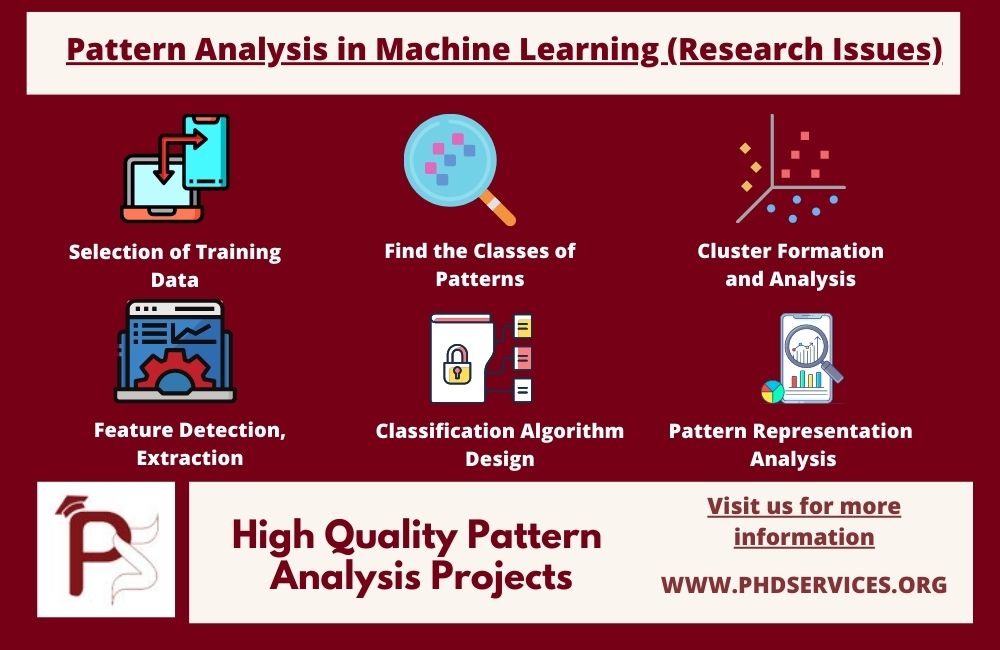
What are the research issues of pattern analysis?
- Type of sensing environment
- Selection of Training Data
- Find the Classes of Patterns
- Cluster Formation and Analysis
- Feature Detection, Extraction, and Optimal Selection
- Classification Algorithm Design
- Pattern Representation Analysis (e.g. Shape)
When the research problem is selected, the next step is to select corresponding research solutions which are effective to crack the proposed problem. Here, we have given you the common pattern analysis techniques with their condition, representation, and function. Similarly, we also guide you in selecting your research solution. Our proposed techniques are always unique from others since we only prefer the smart way of solving problems. So, your experimental results denote the efficiency of your proposed techniques than the previous common techniques.
Common Pattern Analysis Approaches
- Statistical
- Inputs– Feature
- Classification Function– Discriminant Method
- Neural Network
- Inputs– Feature, Sample, and Pixel
- Function– Network Method
- Template Matching
- Inputs– Curves, Sample, and Pixel
- Function– Distant Measurement and Correlation Method
- Structural and Syntactic
- Inputs– Feature, Sample, and Pixel
- Function– Grammar and Rule
From the above list, we have taken the “statistical” method as an example for illustration and given you more important techniques for pattern recognition. We ensure you all these techniques are accurate in any sort of complex problem.
Statistical Techniques for Pattern Recognition
- Posteriori Probability Estimation
- Improved K-NN Rule
- Non-linear Discriminant Analysis
- Linear Discriminant Analysis
- Principal Component Analysis
- Parzen Window Density-based Classifier
For your information, here we have given you the flow of the pattern analysis in machine learning algorithms. This process is classified into training and testing phases. At first, the dataset is split into training and testing data. On training data, perform the following steps to learn the patterns over data. On testing data, perform the following steps to classify data based on learned data overtraining. Likewise, we support you in your project implementation like tool selection, dataset selection, code execution, performance analysis, etc. To make you clear in project flow, we provide a step-by-step plan before development.
Working Flow of Pattern Analysis
- Training
- Perform pre-processing over input train data
- Then, extract the key features and select the optimal one
- Next, learn the patterns of data
- Testing
- Perform preprocessing over test data
- Then, measure extracted features
- Next, perform classification process based on learning
What is the purpose of Machine Learning in Pattern Analysis?
Generally, machine learning over pattern analysis technically creates so many benefits. These algorithms are capable to process unstructured data efficiently. Also, it enables you to solve any sort of complex problem. Overall, machine learning provides you with advanced techniques to overcome the imbalance of data on both low and large-scale pattern recognition systems. For illustration, here we have given you two-class and multi-class problems.
Binary Classification
- To classify training data, construct balanced training multiset
- Select different number of minority class instances based on application requirements
- Include different numbers of majority class instances which is equal to minority class instances
Multiclass Classification
- Construct the multiset in balanced nature and test them with a classifier
- Normalize the data balance by multi-classes where each class addresses equal training and testing datasets
Further, we have given you a list of supervised and unsupervised learning techniques in machine learning. All these techniques are most widely used in the latest pattern recognition projects. In the case of complexity, we also prefer to use hybrid techniques to solve research problems effectively.
Here, each technique has special characteristics and a unique purpose. So, it is necessary to choose the optimal techniques for your project. Consider whether the proposed technique is an effective and simplified one. Overall, we work on possible ways to meet your project requirements regardless of research hurdles.
Machine Learning Algorithms for Pattern Recognition
- Supervised Techniques
- Maximum Entropy Classifier
- Neural Network
- Quadratic Discriminant Analysis
- Perceptrons
- Kernel Assessment
- Linear Discriminant Analysis
- Naïve Bayes Classifier
- Gene Expression Programming
- Decision Tree
- Support Vector Machine
- K-Nearest Neighbor
- Unsupervised Learning
- K-Means Clustering
- Kernel PCA
- Deep Learning
- Correlation Clustering
- Categorical Mixture Techniques
- Hierarchical Clustering
There are some algorithms in machine learning for accurate pattern recognition. We listed some of the algorithms are below.
- Linear Dynamical Systems
- Extended LDS
- LDS-based Learning
- Particle Filters
- LDS-based Inference
- Nonlinear Latent Variable Models
- Modeling Nonlinear Manifolds
- Independent Component Analysis
- Auto-Associative Neural Networks
- Probabilistic PCA
- EM Algorithm
- Factor Analysis
- Maximum likelihood PCA
- Bayesian PCA
- Hidden Markov Models
- Sum-product Method
- Viterbi Algorithm
- Extended HMM
- Forward-backward Approach
- Maximum likelihood
- Scaling Factors
The ultimate objective of pattern detection is to classify the data based on unsupervised or supervised classifier algorithms. Although pattern detection systems have different frameworks, machine learning algorithms are recognized as widely used algorithms to acquire expected accurate results regardless of large-scale data-intensive complexity. Here, we have given you the list of feature mining and extraction methods to narrow down processing data for pattern recognition.
Feature Extraction Methods in Pattern Recognition
- Principal Component Analysis (PCA)
- Attribute – fast, eigenvector-based, linear map
- Linear PCA
- Attribute – iterative and linear map
- Nonlinear PCA
- Attribute – iterative, non-Gaussian criterion, linear map
- Independent Component Analysis (ICA)
- Attribute – iterative, non-Gaussian, linear map
- Linear Discriminant Analysis
- Attribute – fast, eigenvector-based, supervised linear map
- Kernel PCA
- Attribute – eigenvector-based, nonlinear map
- Self-Organizing Map (SOM)
- Attribute – iterative, nonlinear
- Sammon’s Projection and Multidimensional Scaling (MDS)
- Attribute – iterative, nonlinear map
- Non-Linear Auto-Associative Network
- Attribute – iterative, nonlinear map, non-Gaussian criterion
Nowadays, one of the subsets of ML techniques called neural networks is largely employed in current pattern analysis projects. Since it is best to operate on a large amount of data for precise prediction and classification processes. Overall, this helps to find or generate the patterns classes or nature. In the earlier section, we have already seen the ML variants in pattern recognition. Here, we have given you ML variants in pattern analysis for your knowledge. To the great extent, we also serve you in other emerging research techniques of pattern analysis in machine learning.
Different Types of Machine Learning Algorithms for Pattern Analysis
- Multilayer Perceptron
- Recurrent Neural Network
- Sequence-to-Sequence Models
- Modular Neural Network
- Long Short-Term Memory
- Feed Forward Neural Network
- Radial Basis Function Neural Network
- Convolutional Neural Network
- Kohonen’s LVQ
For add-on benefits of active scholars, our resource team has shared with you the top 2 primary research areas of pattern recognition. Along with these, we also included current research ideas that are in high demand. Likewise, we also support you in other important research areas of pattern recognition. Once you share your desired research areas, we provide you list of research ideas that relate to pattern recognition and analysis. Also, we guarantee you suitable machine learning algorithms based on your handpicked research problems.

Latest Research Areas in Pattern Recognition
- Computer Vision – Main operations are image segmentation, image processing, scene recognition, scene interpretation, and object recognition
-
- Industrial Internet of Things Applications
- Video / Image Analysis and Interpretation
- Medical Imaging and Analysis
- Fast Information Extraction and Retrieval
- Pattern Recognition – Main operations are pattern recognition, statistical analysis, feature extraction, structural analysis, feature selection, and assessment
- Multimedia Data Processing
- Pattern Analysis for Data Clustering
- Advance Document Investigation
- Biometric-based User Authentication
- Virtual and Augmented Reality in Healthcare
- Handwriting Recognition and Analysis
- Robotics and Computer Vision in Industries
Further, if you need other important research areas with ideas in pattern analysis then approach our team. Once you approach us, we let you know everything in your requested information. We assure you that we provide the fullest support in developing selected research ideas through best-fitting implementation technologies. Besides, we also give our assistance in thesis/dissertation writing. We hope that you won’t miss this chance to achieve your targeted ambition in the field of pattern analysis in machine learning.