


In order to choose signal processing topics for your research, we encourage you to have a talk with our experts. Signal Processing is the technique in which real-world analog signals are interpreted using digital software and algorithms.
What is actually done in digital signal processing?
- Firstly the signals around us or analogue in nature. So hardware for signal processing first converts the obtained analog signals into digital forms.
- In digital forms of the signals appropriate algorithms are applied to process them.
- More emphasis is given to design the most optimal digital processing algorithm.
In this article, we have attempted to give an overall perspective on research in digital signal processing. With the clearly explained fundamentals and the demonstrations of advanced research signal processing topics with investigations and evaluations provided below, this article can be of great use in your research. First, let us start with the reasons for digital signal processing systems to be popular these days.
WHY HAS DIGITAL SIGNAL PROCESSING BECOME SO POPULAR?
When compared to the processing of analog signals, digital signal processing techniques are advanced and easy to process. The merits of digital signal processing systems can be understood by the following properties.
- Realizable Complex algorithms (analog signals have limitations in complex algorithms)
- Low production cost (analog signal processing system is high cost)
- Extraordinarily precise on the basis of complexity and cost (limited precision in case of analog signals)
- Accurately realizable responses of linear phase frequency (response is only approximate in analog signals)
- Aging is not a problem with digital while it is a problem with analogue signals
In order to comply with the objectives of the system and to ensure interconnectivity, digital signal processing developers should take up many advanced methods which would enhance the performance of their system.
Embedded systems are greatly used these days in signal processing hardware. The integrated chips and embedded systems have the capacity to improve performance and register reduction in power consumed.
But the disadvantages associated with embedded peripherals are
- Its Reduced Flexibility To Adapt To Various Applications And
- The Higher Cost Of Installation
So while choosing your signal processing topics for research, you should be crystal clear of your research objective. If you wish to use advanced technologies in your system, then you should also ensure you rectify their drawbacks. Or you can prefer to solve the existing research questions. For any of these purposes, you should have some idea of the research challenges in signal processing, which we are going to see in the next section.
RESEARCH CHALLENGES IN SIGNAL PROCESSING
Every field of research has its own obstacles. Likewise, the digital signal processing systems have the following limitations, which require in-depth research to be solved.
- Infrastructural limitations (technical constraints easily solvable through making efficient methods)
- Switching over or getting adapted to advanced algorithms (it depends on the ability of system to comply with novel methods)
These limitations are not complicated. Rather it takes some amount of deep research into them to easily rectify these problems. Experts witness an upsurge in digital signal processing research these days, with their objectives being limited to solve such limitations mentioned above.
So our advice is to have deep insight into the experimental objectives that are designated for different signal processing applications till today. To aid you in this regard, we have provided the objectives of signal processing applications below.
OBJECTIVES OF SIGNAL PROCESSING APPLICATIONS
Signal Processing applications are not limited at all. They make a huge difference in our day-to-day lives. To understand how the signal processing systems work to ensure simple solutions to us, we need to look into the following experimental objectives.
- Decisions in voice interpretation (identification of the part with high energy in a speech)
- Identification of phonetics (using spectrograms for identifying phonetics)
- Identifying gender (LPC or linear predictive coding estimate for gender identification)
- Identifying control words (audio tape system controlled by voice)
- Analysis of formants (using spectrograms and fast Fourier transform)
- Identification of formants (using discrete cosine transform or DCT)
These are specific objectives for which digital signal processing technique is used. Our experts have delivered many projects fulfilling these objectives. When you get in touch with us, we will give you a complete insight into the research signal processing topics that we guided. Our engineers are still working to remove small imperfections and limitations in the system of signal processing. We can guide you throughout your research and make your project the most optimal solution to many research problems. Now let us see about the digital signal processing methods.
DSP METHODS
There are several methods associated with digital signal processing. The methods depend on certain parameters of signal processing systems. Let us have a quick look at these methods of digital signal processing.
- Model based methods
- Parametric estimation
- Models based on observer
- Parity vector
- Signal Processing based methods
- Time domain
- Frequency domain
- Time frequency domain
- Linear
- Quadratic
- Time series Forecasting methods (nonlinear, non stationary)
- Non parametric
- Nonparametric bayesian
- Local topology and neighbourhood
- Functional decomposition
- Parametric
- Neural networks
- Hidden Markov
- Classical autoregressive models
- Support vector machines
- Non parametric
Our engineers are well versed in handling these digital signal processing methods. You might have worked on one or more of these methods previously. If you have any queries regarding these, you can instantly approach our experts, who are happy to guide you always.
Though the applications of digital signal processing are wide-ranging, there are demands arising for researches in the signal processing field to fulfill every now and then. So in the following section, let us have some idea on current domains of digital signal processing.
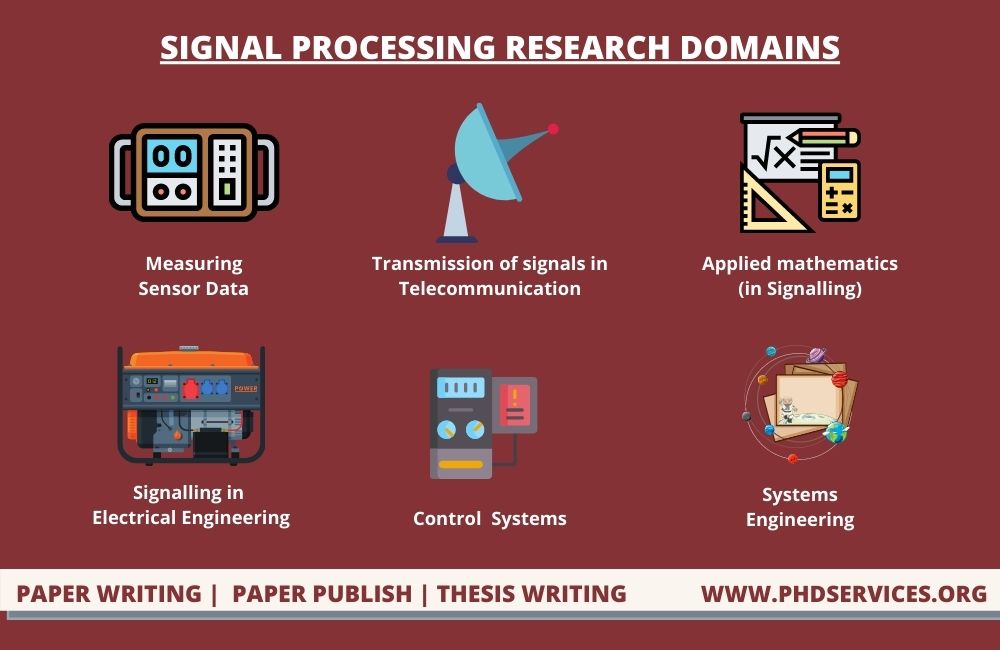
CURRENT RESEARCH DOMAINS IN DIGITAL SIGNAL PROCESSING
The following are the latest domains in which signal Processing finds huge applications. Research is also increasing in these signal processing topics. Have a look into them and get in touch with us and get to know some fine details about the topics that we rend guidance in these domains from our technical experts.
- Measuring sensor data values that vary with time
- Transmission of signals in telecommunication
- Applied mathematics (in signalling)
- Signalling in electrical engineering
- Signals (digital and analog)
- Signal processing in control systems
- Signalling and systems engineering
These are the most trending domains for research in digital signal processing. You can get all types of research support for signal processing topics in any of these domains from us. Our engineers are smartly working on these fields of signal processing by incorporating newer techniques into them.
There are some specific research topics prepared by our experts using reliable sources for signal processing projects. We have discussed them in detail below.
PROJECT IDEAS IN SIGNAL PROCESSING
Refer to the following project ideas in signal processing before choosing your topic of research in it. This can be a huge support to you in order to understand the recent research demands.
- Modeling
- Technology for formatting (and display)
- Tracking of transmission (and recoding)
- Data compression (decoding and coding)
- Perpetual quality assessment
- DSP/ASIC processors
- Merits, limitations and novel applications of SoC human factors
- Streaming and broadcasting of digital signals
- Sampling capture (up and down)
We are currently rendering research guidance on all the above topics. Our technical team has ultimate expertise in solving the research challenges of these topics too. So you can rely on us for your entire research support.
There are some processing techniques in DSP projects that require an understanding of the underlying phenomena. Now let us have some insight into one such concept that is the digital signal optimization processes.
WHAT IS OPTIMIZATION IN SIGNAL PROCESSING?
Code optimization techniques are necessary for certain research requirements in digital signal processing. There are some constraints in real-time that create stress on currently available CPU memory. So it is only the optimization method that can get our projects out of these limitations. Optimization techniques are carried out based on the following parameters.
- Speed of execution
- Bandwidth (input and output)
- Consumption of power
- Usage of memory
Specific parameters are associated with specific optimization processes. Relation between the size of the code and enhanced performance is attributed to these above parameters. We would like you to consider the following points on signal optimization.
- Usage of resources can be of great importance in designing optimized hardware.
- Related simulation methods as algorithms are similar
- But the external events are not similar always. They get varied from instance to instance.
- Time for execution of simulation should me minimum ( it depends on the type of simulator used)
For further more details on these aspects contact our experts. We will give you deep insight into all the details, even including the smallest of the information required for your research. Now let us have some idea on DSP simulation.
DSP SIMULATION TOOLS
Simulation methods are used to implement and check the performance of the designed signal processing system. Having deep knowledge of them can only aid in choosing the best simulator for you. The following are the simulators used in digital signal processing systems.
- Device functional simulator
- Modelling instruction sets, timers and interruptions
- Programming of features like caches, selector, DMA and McBSP
- Analysis Toolkit
- Analysis of code efficiency and its robust nature
- ATK or Analysis Toolkit setup gives you more information regarding its technicalities.
- CPU Cycle Accurate Simulator
- Modelling of timers and instruction set
- Debugging is allowed
- Program optimization for size of the code (and also CPU cycles)
- Device cycle accurate Simulator
- Modeling of caches (and peripherals)
- Measurement of devices
- Stall cycles
- MATLAB Simulink
- Python tools
The choice of a simulator from the above list depends on the specific application for which the system is designed. You can approach us at any time regarding research support for innovative signal processing topics. Our technical team is ready to guide you throughout your research.