


A signal represents the dynamic relationship between two parameters. Voltage variations in an electric circuit and image contrast variations are the best examples of a signal. When an output signal is produced for input, then there is the involvement of a system. This is a short overview of signals and systems project ideas for phd & ms scholars.
What are the signals and systems?
- A signal can be described as a time-varying function holding one value that delivers data.
- You can also say that a function has a unique value at every instant.
- The value can represent both real and complex functions in the form of real and complex data respectively.
- As stated before, a voltage signal varying with time in an electric circuit is one of the best examples of a signal
- A system can be defined as a set of physical components that are involved in taking up signals and processing them to produce an output
Therefore, signals and systems are inseparable aspects of any signal processing mechanism where the desired output is obtained through proper system designs and mathematical functions. To get better ideas on all the basics associated with signal processing you can reach out to us where you can also get several trending signals and systems project ideas.
With our research experience of 15 years in the field of Signals and Systems, our experts can deal with all the project ideas and their issues with huge efficiency and technologically advanced consistency. We will explain everything from basics to advanced approaches. In this regard let us now have a look into the fundamentals of signals and Systems below,
Fundamentals of Signals and Systems
- The set of processes, devices, and algorithms that are operated together to process an input signal to produce an output is called a system
- What is a continuous and discrete-time system?
- The name continuous-time and discrete-time systems are obtained following the nature of inputs and outputs respectively being continuous and discrete
- It is considered concerning the time domain
- What are the prerequisites for Signals and Systems?
- Mathematics is highly important for a researcher working in Signals and Systems project ideas
- The models developed with mathematics foundation are greatly important as you can perform signal analysis, processing, prediction apart from system design using them
- What are the two types of system models?
- State models (or internal models) – state-space
- Input and output model representations – transfer function
- What are the different types of input and output models?
- Differential equations
- Transfer functions – Fourier, z -transform, Laplace functions
- Convolution models
These analysis tools find applications in different fields of research. In line with the above description all the mathematical inputs, output models, and their functions in all domains will be provided to you by our technical team who are very well experienced in handling them. Also, you can get all kinds of research and project help regarding Signals and Systems from our experts at any time. Let us now look deep into the definition of signals,
What are signals?
The representations of independently varying functions are called signals. The following are the real-time examples of a signal,
- A biological signal is a gene base sequential pattern
- A video signal is nothing but an image intensity variation
- An acoustic signal is a speech or audio signal processing
- An electric signal is a current and voltage variation in a circuit
Hence signals are available in different forms both possible and impossible for humans to perceive. It is in the hands of researchers, system designers, and developers like you to promptly establish systems for acquiring and processing such signals.
We have been helping researchers and final year students to develop their signals and system project ideas efficiently. Let us now look into the major applications of signals and Systems below.
This article provides a complete picture of Signals and Systems project ideas where we will first start by understanding the basics of signals and Systems.
Applications of Signals and Systems
- Security systems and robotics
- Industries and their automation
- Automobile sector and mobility functions
- Smart cities, buildings, and grids
- Health sector and medical purposes
- Environmental and agricultural aspects
Furthermore, advanced applications are now being developed based on many successful signals and systems project ideas. Our creative technical team has supported the development and success of many innovative project ideas in signals and systems for quite a long time as a result of which we gained huge technical expertise. We shall now see about the mathematical representation of a signal,
Mathematical representation of a signal
- Dependent and independent variables are the basic components of any signal represented mathematically,
- X(t) = t2 +1 is the best example of the mathematical form of a signal
- Also a signal in its sinusoidal form can be represented as follows
X (t) = A sin (2pift + theta)
- Amplitude, phase, and frequency are the three important components of any signal
So a proper and acceptable mathematical and statistical knowledge becomes essential for designing and implementing signals and system projects.
Here are our experts waiting to help you in submitting your project proposals, thesis, assignments, and any other form of writing which are the essential aspects of any project. We have highly qualified and skilled teams of writers, developers, and experts to fetch you more success in your career. Let us now talk about the different types of signals below
What are the types of signals?
The following are the major classifications or the different types of signals
- Imaginary and real signals
- Aperiodic and periodic signals
- Non deterministic and deterministic signals
- Power and energy signals
- Discrete and continuous-time signals
- Odd and even signals
To know the real-time examples of various systems designed for working with these signals, check out our website. The latest ideas and trending projects in Signals and Systems are compiled by our experts for your reference. Get in touch with us to have access to huge resources of reliable data for your signals and systems projects. Let us now look into the kinds of systems
What are the types of systems?
The following are the different types of systems
- Unstable and stable systems
- Non-causal and causal systems
- Dynamic and static systems
- Time variant and invariant linear functions
- Noninvertible and invertible systems
- Nonlinear and linear systems
Generally, our experts give out timely resolutions for issues about these systems so that it becomes very easy for our customers to carry out successful research. You can make your research career in signals and Systems interesting and fruitful with the help of our experts’ team. Let us now look into the functions in signals and Systems,
What are the functions of signals and Systems?
- Shifting
- Signal movement within the domain of amplitude and time is called shifting
- Following the above definition, shifting is categorized into amplitude and time-shifting respectively
- Reversal
- You can multiply the time of the signal with – 1 to obtain the time-reversal of a particular Signal
- Integration
- Time-domain summation of signals refers to signal integration
- Sampling
- Taking up samples are simply referred to as sampling
- When digital signal samples along the x-axis are taken, it is the best example of sampling
- It is carried out over independent variables
- Flat top, natural, and impulse sampling are the three different kinds of sampling methods
- Scaling
- Multiplying a constant signal in its amplitude or time domain is called scaling
- Quantization
- When you divide a signal into multiple partitions or quanta, then it is called quantization
- Quantization can be carried out on dependent variables
- It is also considered to be the opposite function of sampling
- Differentiation
- Representation of a signal along a slope as a function of time is called differentiation
Most often highly technical and detailed explanations concerning these functions are provided as proper technical notes so that it becomes easy for you to understand and comprehend them. We are also well known among research scholars and students across the world for our reliable explanatory notes, descriptions, and demonstrations. So you can get all your doubts cleared regarding signals and Systems from us. Let us now see about the methods of signals and Systems below
Signals and Systems Methods
- Stationary signals
- Frequency domain
- Cepstrum analysis
- Spectral and envelope analysis
- High order spectrum
- Non-stationarysignals
- Wavelets
- Wavelet packet transform
- Hilbert – Huang transform
- Morlet wavelet
- Continuous and discrete wavelet transform
- Time-frequency
- Cyclostationary analysis
- Spectral kurtosis and Wigner – Ville distribution
- Short-time Fourier Transform
- Empirical mode decomposition
These methodologies are detailed explained on our website on signals and Systems project ideas where you can also look into our successful projects in the field. We are also assured to stand with you for executing algorithms, writing codes, and implementing the projects in real-time. We will now look into the current trends in signals and system projects below,
Current Trends of Signals and Systems
- SCI or Sensors Circuits and Instrumentation systems
- SAC or Systems Automation and Control
- PSE or Power systems and Smart Energies
At present we are offering complete project support on all current trends in signals and systems for which you can get ultimate support from us. Once you choose your topic you can intimate it to our experts and interact with us to gain details on all the aspects regarding its feasibility. The following gist on recent project areas in signals and systems can be of great use to you to choose the topic that interests you.
Latest 4 Research Areas in Signals and Systems
AI signals and systems
- Interface between human brains and machines via multiple agents
- Artificial intelligence system for management of disasters
- Machine learning waste assistive robot cognitive learning
- Living infrastructure assisted by the ambiance
- Designing robots for ocean and space exploration
Wireless Signal and Systems
- Signal reception antennas for satellite communication
- Acquiring signals without noise
- Modelling and analyzing underwater signals
- Schemes for detecting modulations
- M2M and D2D communication based OFDMA
Bio Signals and Systems
- Decoding in real-time for processing signals
- Methods for detecting and removing the artifacts
- Processing of physiological signals
- Analysing multiple signals and features
- Diagnosis of diseases such as heart, brain, and lung illness
Digital Imaging and Systems
- Morphological segmentation methods
- Reconstruction of three-dimensional images and ideas in real-time
- Retraining medical images based on content
- Recognition of images and patterns
- Geosciences and Remote Sensing applications
Without a doubt, you can get both qualitative and quantitative research data along with the technical support needed for your project on all these topics. Software and Hardware implementations and requirements needed to complete these projects will be provided to you instantly. In this regard, let us have a look into the signals and system project tools below,
Project tools for signals and Systems
- Octave
- You can use octave for fast Fourier transforms and Signal Processing application development
- FFTPACK and FFTW are the major octave signal processing libraries for fast Fourier transform functions
- Visual Basic
- Many kinds of classes can be used for signal generation and its interface implementation
- The signal output is the previous signal function value
- For instance, SIG_IGN is obtained as the return value when SIG_IGN is the previous function value
- Errno can be set as EINVAL when an error is indicated in SIG_ERR
- SciPy
- SciPy consists of the following toolboxes for processing signals
- Filtering function implementation toolbox
- Filter design toolsets
- One and two-dimensional data-based B – spline interpolation algorithms
- B – spline algorithms form a part of interpolation functional category
- Fast B – spline transforms can be obtained by the formalism of transfer functions and filter theory
- CppSim
- The auto ordering algorithms can be used for obtaining minimum induced delays and ordering the blocks by creating netlist codes in the CppSim package
- Different blocks are applied as objects within a system in which the outputs are updated with the sampling rate of one
- As a result Faster simulation performance is offered by this
- Large systems are effectively represented in great detail by this approach
- Multiple steps can be simulated in considerable runtimes and without consuming a lot of memory
- Signal Application Testing System (SATs)
- Designs are needed when installing multiple switches in multiple family buildings
- The following are there important calculation input parameters
- Table section length
- Cable Type
- Multi Switches count and type
- Network topology
- System components are to be selected by the designer
- For establishing well-developed signal designs, suitable testing and simulation steps have to be performed for supporting rail system testing Automation
- Specific processes are instilled by test managers in SATs
- It can be used for better management of expanding software portfolios
- MATLAB and MATLAB Simulink
- There are multiple MATLAB toolboxes and tools for signal and system functions as given below
- Wavelet and signal processing
- Data acquisition and DSP system
- Statistics and machine learning
- EPICS
- MDSplus event occurrences can be synchronized with waveform records using appropriate devices
- Raw event creation value becomes the VAL field data, as you receive the event
- Requirements of configuration can then be applied
Check out our website at any time for a more detailed explanation of these tools. You can also talk to our experts regarding the doubts in signals and Systems. If you think real-time examples and implementations of signal and system projects are important then reach out to us without hesitation. What are the top project ideas in signals and Systems?
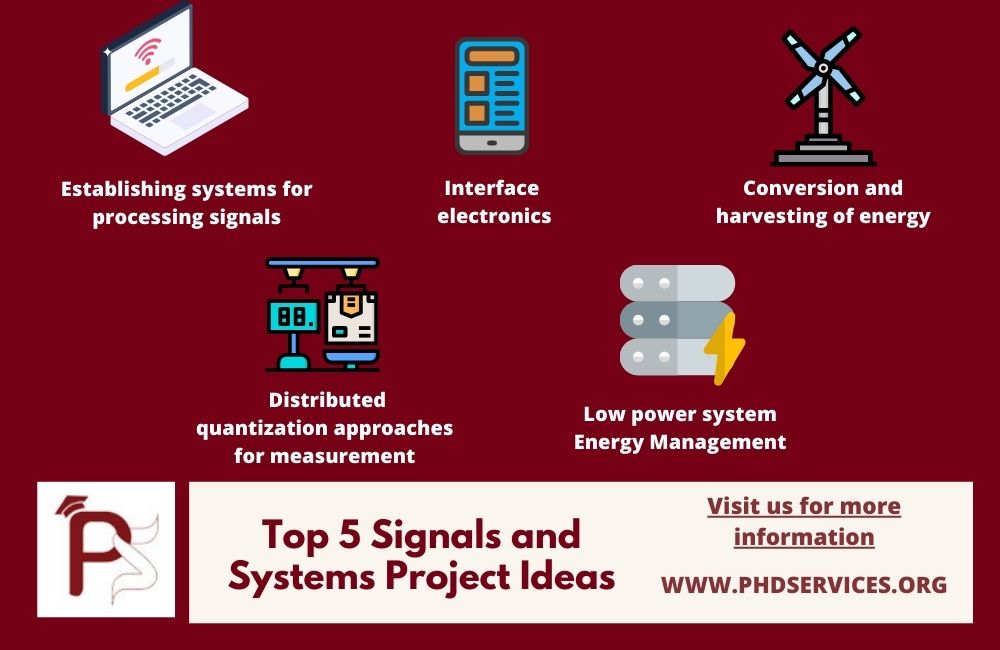
Top 5 Signals and Systems Project Ideas
- Creating models and establishing systems for processing signals from sensors
- Interface electronics and signal conditioning techniques
- Conversion and harvesting of energy
- Acquisition of data and distributed quantization approaches for measurement
- Low power system Energy Management methods
Notably, these topics are gaining significance due to the development of the latest technologies like deep learning, machine learning, and artificial intelligence.
We have separate teams of technical experts to guide you in all these recent technologies. These are the topmost and trending signals and Systems project ideas for which we assure to offer full project help all the time. When provided with reliable and authentic research data along with our crucial technical help any signal and system project ideas can be successfully implemented. Get in touch with us for any type of project support in signals and systems.